
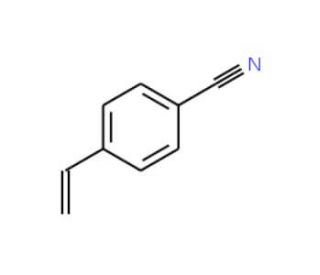

4-Cyanostyrene (CAS 3435-51-6)
QUICK LINKS
4-Cyanostyrene is a chemical compound that functions as a reactive monomer in polymerization reactions. It acts as a building block for the synthesis of various polymers and copolymers, contributing to the formation of new materials with tailored properties. Its mechanism of action involves undergoing polymerization reactions with other monomers, leading to the formation of long chains of repeating units. This process allows for the creation of polymers with specific characteristics, such as thermal stability, mechanical strength, and chemical resistance. 4-Cyanostyrene′s role in the experimentation is to serve as a precursor for the development of novel polymeric materials, enabling the ability for potential applications of the resulting polymers in various fields. Its molecular structure and reactivity make it a component in the design and synthesis of advanced materials with tailored properties.
4-Cyanostyrene (CAS 3435-51-6) References
- On the hydrolysis step in osmium catalyzed asymmetric dihydroxylations. | Junttila, MH. and Hormi, OE. 2007. J Org Chem. 72: 2956-61. PMID: 17378614
- Enantioselective CuH-Catalyzed Reductive Coupling of Aryl Alkenes and Activated Carboxylic Acids. | Bandar, JS., et al. 2016. J Am Chem Soc. 138: 5821-4. PMID: 27121395
- Photoinduced oxidative activation of electron-rich arenes: alkenylation with H2 evolution under external oxidant-free conditions. | Hu, X., et al. 2018. Chem Sci. 9: 1521-1526. PMID: 29675195
- Synthesis of Phthalans Via Copper-Catalyzed Enantioselective Cyclization/Carboetherification of 2-Vinylbenzyl Alcohols. | Chen, D. and Chemler, SR. 2018. Org Lett. 20: 6453-6456. PMID: 30336677
- Construction of a Different Polymer Chain Structure to Study π-π Interaction between Polymer and Reduced Graphene Oxide. | Zhao, D., et al. 2018. Polymers (Basel). 10: PMID: 30960641
- Organocatalytic Olefin Aziridination via Iminium-Catalyzed Nitrene Transfer: Scope, Limitations, and Mechanistic Insight. | Johnson, SL. and Hilinski, MK. 2019. J Org Chem. 84: 8589-8595. PMID: 31173691
- Leveraging Actinide Hydrolysis Chemistry for Targeted Th and U Separations using Amidoxime-Functionalized Poly(HIPE)s. | Piechowicz, M., et al. 2020. Chemphyschem. 21: 1157-1165. PMID: 32363763
- Synthesis, Resolution, Configurational Stability, and Properties of Cationic Functionalized [5]Helicenes. | Marinova, M., et al. 2020. J Org Chem. 85: 11908-11923. PMID: 32907321
- Nitrogen-Based Linkers with a Mesitylene Core: Synthesis and Characterization. | Bahrin, LG., et al. 2021. Molecules. 26: PMID: 34641496
- Sonochemical Reaction of Bifunctional Molecules on Silicon (111) Hydride Surface. | Zida, SI., et al. 2021. Molecules. 26: PMID: 34684747
- Sustainable and highly controlled aryl couplings revealed by systematic assessment of photoactivatable linkers. | Haensch, VG., et al. 2022. Chem Sci. 13: 5680-5686. PMID: 35694362
- Merging Grubbs second-generation catalyst with photocatalysis enables Z-selective metathesis of olefins: scope, limitations, and mechanism. | Chérif, SE., et al. 2022. Chem Sci. 13: 12065-12070. PMID: 36349104
- Copper-Catalyzed Borylation of Styrenes by 1,8-Diaminonaphthalene-Protected Diboronic Acid. | Yasuda, T., et al. 2023. Org Lett. 25: 2093-2097. PMID: 36947669
Ordering Information
| Product Name | Catalog # | UNIT | Price | Qty | FAVORITES | |
4-Cyanostyrene, 1 g | sc-277332 | 1 g | $150.00 |