
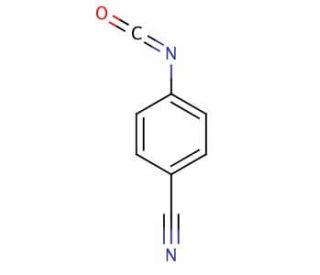

4-Cyanophenyl isocyanate (CAS 40465-45-0)
QUICK LINKS
4-Cyanophenyl isocyanate is a highly versatile compound with broad applications in the chemical, and biological sciences. 4-Cyanophenyl isocyanate finds utility in the study of enzyme-catalyzed reactions, as well as in the exploration of biochemical and physiological processes. The scientific research community has employed 4-Cyanophenyl isocyanate in diverse research applications. It has proven instrumental in investigating enzyme-catalyzed reactions, shedding light on key mechanisms underlying biochemical and physiological processes. Furthermore, the compound has demonstrated its significance in material science by contributing to the development of novel polymers and nanomaterials. Mechanistically, 4-Cyanophenyl isocyanate acts as an isocyanate, readily reacting with amines, alcohols, and thiols to yield amides, esters, and thioesters, respectively. It can also react with water to form a carbamate, which can subsequently undergo hydrolysis to generate an amide. Notably, 4-Cyanophenyl isocyanate exhibits self-reactivity, enabling the formation of a cyclic urea through intramolecular reactions.
4-Cyanophenyl isocyanate (CAS 40465-45-0) References
- Chemical modification of silk sericin in lithium chloride/dimethyl sulfoxide solvent with 4-cyanophenyl isocyanate. | Teramoto, H., et al. 2004. Biomacromolecules. 5: 1392-8. PMID: 15244456
- Carboxylic acid replacement structure-activity relationships in suosan type sweeteners. A sweet taste antagonist. 1. | Muller, GW., et al. 1992. J Med Chem. 35: 1747-51. PMID: 1588556
- Development of a concise, asymmetric synthesis of a smoothened receptor (SMO) inhibitor: enzymatic transamination of a 4-piperidinone with dynamic kinetic resolution. | Peng, Z., et al. 2014. Org Lett. 16: 860-3. PMID: 24502520
- Pyrimidinyl Biphenylureas: Identification of New Lead Compounds as Allosteric Modulators of the Cannabinoid Receptor CB1. | Khurana, L., et al. 2017. J Med Chem. 60: 1089-1104. PMID: 28059509
- Synthesis and anion binding studies of tris(3-aminopropyl)amine-based tripodal urea and thiourea receptors: Proton transfer-induced selectivity for hydrogen sulfate over sulfate. | Khansari, ME., et al. 2015. RSC Adv. 5: 17606-17614. PMID: 28184300
- Synthesis and Leishmanicidal Activity of Novel Urea, Thiourea, and Selenourea Derivatives of Diselenides. | Díaz, M., et al. 2019. Antimicrob Agents Chemother. 63: PMID: 30782984
- 2,2-Dimethyl-3,4-dihydro-2H-1,4-benzoxazines as isosteres of 2,2-dimethylchromans acting as inhibitors of insulin release and vascular smooth muscle relaxants. | Pirotte, B., et al. 2019. Medchemcomm. 10: 431-438. PMID: 31015906
- Structural Optimization of the Diarylurea PSNCBAM-1, an Allosteric Modulator of Cannabinoid Receptor 1. | Dopart, R., et al. 2020. Curr Ther Res Clin Exp. 92: 100574. PMID: 32021660
- Selective Carboxylate Recognition Using Urea-Functionalized Unclosed Cryptands: Mild Synthesis and Complexation Studies. | Niedbała, P., et al. 2020. J Org Chem. 85: 5058-5064. PMID: 32142280
- Design, Synthesis and Biological Evaluation of Phenyl Urea Derivatives as IDO1 Inhibitors. | Zhou, C., et al. 2020. Molecules. 25: PMID: 32210078
- TCT-mediated click chemistry for the synthesis of nitrogen-containing functionalities: conversion of carboxylic acids to carbamides, carbamates, carbamothioates, amides and amines. | Ahmed, R., et al. 2022. Org Biomol Chem. 20: 4942-4948. PMID: 35660834
- Hydroboration of isocyanates: cobalt-catalyzed vs. catalyst-free approaches. | Gudun, KA., et al. 2022. Org Biomol Chem. 20: 6821-6830. PMID: 35968649
- Selective hydroboration of electron-rich isocyanates by an NHC-copper(I) alkoxide. | English, LE., et al. 2023. Chem Commun (Camb). 59: 1074-1077. PMID: 36621804
Ordering Information
| Product Name | Catalog # | UNIT | Price | Qty | FAVORITES | |
4-Cyanophenyl isocyanate, 2 g | sc-232625 | 2 g | $128.00 |