
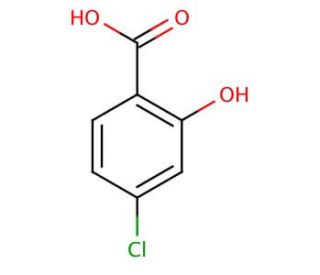

4-Chlorosalicylic acid (CAS 5106-98-9)
QUICK LINKS
4-Chlorosalicylic acid has emerged as a valuable compound in scientific research due to its diverse range of applications and intriguing chemical properties. With its unique molecular structure, 4-chlorosalicylic acid exhibits promising potential as a versatile building block in the synthesis of various organic compounds. Its chlorinated aromatic ring imparts distinctive reactivity, enabling selective functionalization and facilitating the creation of novel chemical entities. Researchers have utilized 4-chlorosalicylic acid as a key precursor in the development of pharmaceutical intermediates, agrochemicals, and materials science applications. Furthermore, its role as a starting material in the synthesis of metal-organic frameworks (MOFs) has garnered considerable interest in the field of coordination chemistry and porous materials research. Additionally, 4-chlorosalicylic acid serves as a model compound in studies investigating the mechanisms of organic reactions and exploring new synthetic methodologies. Its facile synthesis and structural versatility make it a valuable tool for elucidating reaction mechanisms, optimizing synthetic routes, and advancing the frontiers of chemical synthesis. Ongoing research efforts continue to explore the diverse chemical reactivity and potential applications of 4-chlorosalicylic acid, highlighting its significance as a multifaceted building block in organic synthesis and materials science.
4-Chlorosalicylic acid (CAS 5106-98-9) References
- [Structure-activity relationships in the diuretic xipamide (4-chloro-5-sulfamoyl-2', 6' -salicyloxylidide)]. | Liebenow, W. and Leuschner, F. 1975. Arzneimittelforschung. 25: 240-4. PMID: 1173040
- Spectrofluorometric determination of trace amounts of terbium with 4-chlorosalicylic acid, EDTA, and cetyltrimethylammonium bromide. | Jiang, W., et al. 2003. Anal Sci. 19: 923-5. PMID: 12834236
- Impact of membrane fatty acid composition on the uncoupling sensitivity of the energy conservation of Comamonas testosteroni ATCC 17454. | Loffhagen, N., et al. 2006. Appl Microbiol Biotechnol. 70: 618-24. PMID: 16133339
- Isolation and characterization of dibenzofuran-degrading Serratia marcescens from alkalophilic bacterial consortium of the chemostat. | Jaiswal, PK. and Thakur, IS. 2007. Curr Microbiol. 55: 447-54. PMID: 17710482
- Salicylic acid and some of its derivatives as antibacterial agents for viscose fabric. | Kantouch, A., et al. 2013. Int J Biol Macromol. 62: 603-7. PMID: 24076193
- Structural and functional characterization of a stable, 4-chlorosalicylic-acid-degrading, bacterial community in a chemostat. | Thakur, IS. 1995. World J Microbiol Biotechnol. 11: 643-5. PMID: 24415012
- Salicylanilide diethyl phosphates as cholinesterases inhibitors. | Krátký, M., et al. 2015. Bioorg Chem. 58: 48-52. PMID: 25462625
- Parallel online determination of ethylene release rate by Shaken Parsley cell cultures using a modified RAMOS device. | Schulte, A., et al. 2018. BMC Plant Biol. 18: 101. PMID: 29859042
- New Simple and Robust Method for Determination of Polarity of Deep Eutectic Solvents (DESs) by Means of Contact Angle Measurement. | Cichocki, Ł., et al. 2022. Molecules. 27: PMID: 35807449
- Spotting priming-active compounds using parsley cell cultures in microtiter plates. | Hoffmann, K., et al. 2023. BMC Plant Biol. 23: 72. PMID: 36726070
Ordering Information
| Product Name | Catalog # | UNIT | Price | Qty | FAVORITES | |
4-Chlorosalicylic acid, 5 g | sc-226605 | 5 g | $36.00 |