
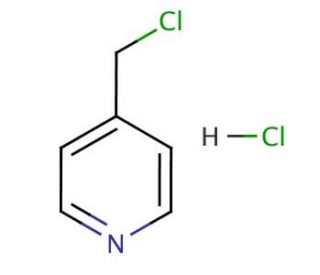

4-(Chloromethyl)pyridine hydrochloride (CAS 1822-51-1)
QUICK LINKS
4-(Chloromethyl)pyridine hydrochloride is an alkylating agent. It acts by forming covalent bonds with nucleophilic groups in molecules, such as DNA, RNA, and proteins, leading to modifications in their structure and function. 4-(Chloromethyl)Pyridine Hydrochloride′s mechanism of action involves the substitution of a hydrogen atom with the chloromethyl group, resulting in the formation of a stable covalent bond. This process can disrupt the normal functioning of biomolecules, potentially leading to altered gene expression, protein function, or cellular signaling pathways. In experimental applications, 4-(Chloromethyl)pyridine hydrochloride is used to study the effects of alkylation on biological systems and to investigate the mechanisms underlying these molecular modifications.
4-(Chloromethyl)pyridine hydrochloride (CAS 1822-51-1) References
- Efficient enantioselective hetero-Diels-Alder reaction of Brassard's diene with aliphatic aldehydes: a one-step synthesis of (R)-(+)-kavain and (S)-(+)-dihydrokavain. | Lin, L., et al. 2008. Org Lett. 10: 1311-4. PMID: 18303910
- Two different one-dimensional supramolecular chains formed from the reaction of 2-[1-(pyridin-4-ylmethyl)-1H-benzimidazol-2-yl]quinoline with two different precursors, Co(NO3)2 and CoCl2. | Wu, XW., et al. 2014. Acta Crystallogr C Struct Chem. 70: 522-7. PMID: 24816026
- Blue Light-Excitable Broadband Yellow Emission in a Zero-Dimensional Hybrid Bismuth Halide with Type-II Band Alignment. | Qi, Z., et al. 2022. Inorg Chem. 61: 19483-19491. PMID: 36383707
Ordering Information
| Product Name | Catalog # | UNIT | Price | Qty | FAVORITES | |
4-(Chloromethyl)pyridine hydrochloride, 10 g | sc-232267 | 10 g | $51.00 |