
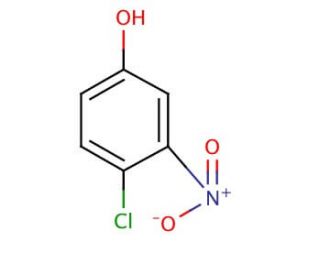

4-Chloro-3-nitrophenol (CAS 610-78-6)
ENLACES RÁPIDOS
El 4-cloro-3-nitrofenol es un compuesto químico que funciona como precursor en la síntesis de diversos compuestos orgánicos. Actúa como componente básico en la producción de tintes y productos químicos agrícolas. El modo de acción del compuesto consiste en participar en reacciones de sustitución aromática nucleofílica, en las que se somete a sustitución con otros grupos funcionales para formar nuevos compuestos químicos. Su función en el desarrollo es servir como material de partida para la síntesis de moléculas más complejas, permitiendo la creación de diversas estructuras químicas para su posterior investigación y aplicaciones potenciales en diversas industrias. A nivel molecular, el 4-cloro-3-nitrofenol interactúa con otros reactivos para facilitar la formación de nuevos enlaces químicos, permitiendo la creación de compuestos novedosos con propiedades únicas para su exploración experimental.
4-Chloro-3-nitrophenol (CAS 610-78-6) Referencias
- La reducción quimioselectiva del grupo nitro y la decloración reductora inician la degradación del 2-cloro-5-nitrofenol por Ralstonia eutropha JMP134. | Schenzle, A., et al. 1999. Appl Environ Microbiol. 65: 2317-23. PMID: 10347008
- Análisis QSAR de la toxicidad de los nitroaromáticos en Tetrahymena pyriformis: factores estructurales y posibles modos de acción. | Artemenko, AG., et al. 2011. SAR QSAR Environ Res. 22: 575-601. PMID: 21714735
- Los genes implicados en la degradación del para-nitrofenol están dispuestos diferencialmente en forma de grupos de genes no contiguos en Burkholderia sp. cepa SJ98. | Vikram, S., et al. 2013. PLoS One. 8: e84766. PMID: 24376843
- Degradación bacteriana de clorofenoles y sus derivados. | Arora, PK. and Bae, H. 2014. Microb Cell Fact. 13: 31. PMID: 24589366
- Degradación del 4-cloro-3-nitrofenol a través de un nuevo intermediario, el 4-clororesorcinol, por Pseudomonas sp. JHN. | Arora, PK., et al. 2014. Sci Rep. 4: 4475. PMID: 24667329
- Evaluación de las N-bencilgalactonoamidinas como análogos putativos del estado de transición para la hidrólisis del β-galactósido. | Fan, QH., et al. 2014. Org Biomol Chem. 12: 2792-800. PMID: 24668069
- Aminobenzimidazoles aril-sustituidos dirigidos al sitio de entrada del ribosoma interno del virus de la hepatitis C. | Ding, K., et al. 2014. Bioorg Med Chem Lett. 24: 3113-7. PMID: 24856063
- Biotransformación y quimiotaxis del 4-cloro-2-nitrofenol por Pseudomonas sp. JHN. | Arora, PK. and Bae, H. 2014. Microb Cell Fact. 13: 110. PMID: 25112300
- Caracterización Genética y Bioquímica de la Degradación del 2-Cloro-5-Nitrofenol en una Bacteria Recién Aislada, Cupriavidus sp. Cepa CNP-8. | Min, J., et al. 2017. Front Microbiol. 8: 1778. PMID: 28959252
- Avances recientes en la degradación de cloronitrofenoles. | Arora, PK., et al. 2018. Bioresour Technol. 250: 902-909. PMID: 29229201
- Biodegradación de 2-cloro-4-nitrofenol mediante una vía hidroxiquinólica por una bacteria Gram-negativa, Cupriavidus sp. cepa CNP-8. | Min, J., et al. 2018. AMB Express. 8: 43. PMID: 29560541
- Estimación de la toxicidad de diferentes compuestos aromáticos sustituidos para el ciliado acuático Tetrahymena pyriformis mediante el enfoque QSAR. | Luan, F., et al. 2018. Molecules. 23: PMID: 29695132
- Caracterización de una cepa P31 de Pseudomonas fulva degradadora de piretroides y vía de degradación bioquímica de la D-fenotrina. | Yang, J., et al. 2018. Front Microbiol. 9: 1003. PMID: 29867894
Información sobre pedidos
| Nombre del producto | Número de catálogo | UNIDAD | Precio | CANTIDAD | Favoritos | |
4-Chloro-3-nitrophenol, 5 g | sc-238810 | 5 g | $37.00 |