
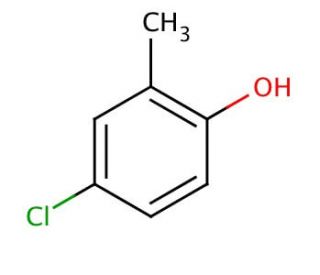

4-Chloro-2-methylphenol (CAS 1570-64-5)
QUICK LINKS
4-Chloro-2-methylphenol is a chemical compound that functions as a bacteriostatic agent in experimental applications. It exerts its mechanism of action by disrupting the cell membrane of bacteria, leading to leakage of cellular contents and ultimately causing cell death. 4-Chloro-2-Methylphenol is known to inhibit the growth and reproduction of a wide range of bacteria, which may be useful for studying bacterial physiology and for developing antimicrobial products. At the molecular level, 4-Chloro-2-methylphenol interferes with the function of enzymes and proteins within bacterial cells, disrupting their normal metabolic processes. This disruption ultimately leads to the inhibition of bacterial growth and survival. In experimental applications, 4-Chloro-2-methylphenol is utilized to investigate the mechanisms of bacterial resistance and to develop strategies for combating bacterial infections. Its mechanism of action at the cellular level provides insights into the development of antimicrobial agents and the understanding of bacterial physiology.
4-Chloro-2-methylphenol (CAS 1570-64-5) References
- Determination of the herbicide 4-chloro-2-methylphenoxyacetic acid and its main metabolite, 4-chloro-2-methylphenol in water and soil by liquid chromatography-electrospray tandem mass spectrometry. | Pozo, O., et al. 2001. J Chromatogr A. 923: 75-85. PMID: 11510563
- Quantitative determination of chlorophenols in leather by pressurized liquid extraction and liquid chromatography with diode-array detection. | Favaro, G., et al. 2008. J Chromatogr A. 1177: 36-42. PMID: 18045610
- Pesticide by-products in the Rhône delta (Southern France). The case of 4-chloro-2-methylphenol and of its nitroderivative. | Chiron, S., et al. 2009. Chemosphere. 74: 599-604. PMID: 18996569
- Fulvic acid-mediated phototransformation of mecoprop. A pH-dependent reaction. | Halladja, S., et al. 2009. Photochem Photobiol Sci. 8: 1066-71. PMID: 19582284
- Photocatalytic degradation of chlorophenols in soil washing wastes containing Brij 35. Correlation between the degradation kinetics and the pollutants-micelle binding. | Davezza, M., et al. 2013. Environ Sci Pollut Res Int. 20: 3224-31. PMID: 23065604
- Simultaneous derivatization and extraction of chlorophenols in water samples with up-and-down shaker-assisted dispersive liquid-liquid microextraction coupled with gas chromatography/mass spectrometric detection. | Wang, KD., et al. 2014. Anal Bioanal Chem. 406: 2123-31. PMID: 23727731
- Electrochemical sensor for simultaneous determination of herbicide MCPA and its metabolite 4-chloro-2-methylphenol. Application to photodegradation environmental monitoring. | Rahemi, V., et al. 2015. Environ Sci Pollut Res Int. 22: 4491-9. PMID: 25315934
- Degradation of mecoprop in polluted landfill leachate and waste water in a moving bed biofilm reactor. | Escolà Casas, M., et al. 2017. Water Res. 121: 213-220. PMID: 28544990
- Laccase-mediated detoxification of phenolic compounds. | Bollag, JM., et al. 1988. Appl Environ Microbiol. 54: 3086-91. PMID: 3223771
- Sustained anaerobic degradation of 4-chloro-2-methylphenoxyacetic acid by acclimated sludge in a continuous-flow reactor. | Zhang, X., et al. 2023. Chemosphere. 330: 138749. PMID: 37086982
- Identification of 4-chloro-2-methylphenol as a soil degradation product of ring-labelled [14C]mecoprop. | Smith, AE. 1985. Bull Environ Contam Toxicol. 34: 656-60. PMID: 4005444
- The estimation of serum acid phosphatase using alpha-naphthyl phosphate as substrate: observations on the use of Fast Red TR salt in the assay. | Cooper, JD., et al. 1982. Clin Chim Acta. 126: 297-306. PMID: 7151283
- Degradation of 4-chloro-2-methylphenol by an activated sludge isolate and its taxonomic description. | Lechner, U., et al. 1995. Biodegradation. 6: 83-92. PMID: 7772944
- Involvement of two alpha-ketoglutarate-dependent dioxygenases in enantioselective degradation of (R)- and (S)-mecoprop by Sphingomonas herbicidovorans MH. | Nickel, K., et al. 1997. J Bacteriol. 179: 6674-9. PMID: 9352915
- Degradation of various chlorophenols under alkaline conditions by gram-negative bacteria closely related to Ochrobactrum anthropi. | Müller, RH., et al. 1998. J Basic Microbiol. 38: 269-81. PMID: 9791948
Ordering Information
| Product Name | Catalog # | UNIT | Price | Qty | FAVORITES | |
4-Chloro-2-methylphenol, 1 g | sc-252142 | 1 g | $23.00 |