
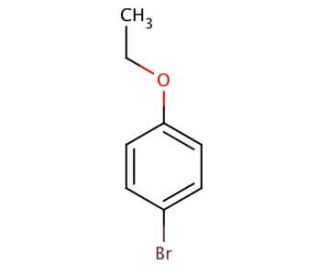

4-Bromophenetole 的分子结构, CAS编号: 588-96-5
4-Bromophenetole (CAS 588-96-5)
备用名:
4-Bromophenyl ethyl ether
CAS号码:
588-96-5
分子量:
201.06
分子式:
BrC8H9O
仅供科研使用。不可用于诊断或治疗。
* 参考分析证明 大量特定数据 (包括水 含量).
快捷链接
订购信息
描述
技术信息
安全信息
安全技术说明书和分析证明书
4-Bromophenetole 是一种在有机合成中用作甲基化试剂的化合物。它作为亲电子体,参与亲核芳香取代反应,将甲氧基引入各种芳香化合物。4-Bromophenetole 的作用模式包括用甲氧基取代芳香环上的一个氢原子,从而形成一个新的碳氧键。这一反应是在特定的反应条件下发生的,因此可以在芳香环上的理想位置选择性地引入甲氧基。在研发过程中,4-溴苯乙醚可用于芳香族化合物的改性,从而合成具有定制特性的各种有机分子。4-Bromophenetole 在分子水平上的精确作用模式使其成为一种有用的试剂,可用于创造新颖的化学结构,并有可能应用于各个领域。
4-Bromophenetole (CAS 588-96-5) 参考文献
- Draize 兔眼试验与人类眼刺激阈值的兼容性:结构-活性关系定量分析。 | Abraham, MH., et al. 2003. Toxicol Sci. 76: 384-91. PMID: 14514959
- 实现生物和医学数学建模的简单随机指纹。3.眼部刺激性分类模型 | Cruz-Monteagudo, M., et al. 2006. Bull Math Biol. 68: 1555-72. PMID: 16865609
- 与艾多昔芬和 4-羟基他莫昔芬有关的雌激素三苯乙烯的结构-功能关系。 | Maximov, PY., et al. 2010. J Med Chem. 53: 3273-83. PMID: 20334368
- 通过考虑对眼睛的刺激,说明 QSAR 在体外毒理学中的实际应用。 | Chamberlain, M. and Barratt, MD. 1995. Toxicol In Vitro. 9: 543-7. PMID: 20650126
- 中性有机化学品眼刺激性 QSARS。 | Barratt, MD. 1997. Toxicol In Vitro. 11: 1-8. PMID: 20654291
- 将 Draize Eye Scores 和人眼刺激阈值结合为一种定量结构-活性关系。 | H Abraham, M., et al. 1998. Toxicol In Vitro. 12: 403-8. PMID: 20654423
- 德雷兹眼刺激数据库的定量结构-活性关系(QSAR)研究。 | Cronin, MT., et al. 1994. Toxicol In Vitro. 8: 21-8. PMID: 20692885
- 作为潜在抗糖尿病药物的新型噻吩 C-芳基葡萄糖苷 SGLT2 抑制剂。 | Lee, SH., et al. 2011. Bioorg Med Chem. 19: 5813-32. PMID: 21906953
- 评估基于西地那非的类似物--磷酸考布他丁 A-4 (CA4P)--作为用于癌症治疗的血管干扰剂。 | Brown, AW., et al. 2018. ChemMedChem. 13: 2618-2626. PMID: 30281922
- 根据化妆品欧洲委员会对体外 STE 和 BCOP 测试方法的分析,为纯液体和稀释液体的眼刺激或严重眼损伤制定明确的方法。 | Alépée, N., et al. 2019. Toxicol In Vitro. 57: 154-163. PMID: 30817952
- EyeIRR-IS 分析法:开发和评估体外测定法,用于测量液体化学品的眼刺激性分类。 | Cottrez, F., et al. 2021. Toxicol In Vitro. 71: 105072. PMID: 33358762
- 利用聚类显著性分析确定毒理学中的不对称 QSAR 数据集。以眼刺激数据为例。 | Cronin, MT. 1996. SAR QSAR Environ Res. 5: 167-75. PMID: 9114513
- QSAR 与体外毒理学的整合。 | Barratt, MD. 1998. Environ Health Perspect. 106 Suppl 2: 459-65. PMID: 9599692
订购信息
| 产品名称 | 产品编号 | 规格 | 价格 | 数量 | 收藏夹 | |
4-Bromophenetole, 100 g | sc-232511 | 100 g | $79.00 |