
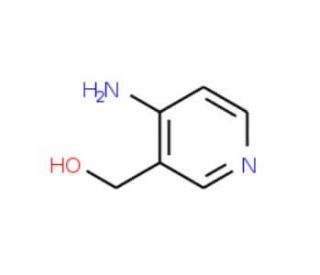

4-Aminopyridine-3-methanol (CAS 138116-34-4)
See product citations (3)
QUICK LINKS
4-Aminopyridine-3-methanol, also known as (4-Aminopyridin-3-yl)methanol, is a versatile compound extensively utilized in scientific research. Its applications span a wide range, including studies on enzyme activity, utilization as a substrate for biocatalytic reactions, and synthesis of various compounds. Moreover, 4-Aminopyridine-3-methanol finds utility in investigations pertaining to protein structure and function, serving as a model system for examining the impact of small molecules on biological processes. The proposed mechanism of action suggests that 4-Aminopyridine-3-methanol binds to proteins and enzymes, leading to alterations in their structure and function. Furthermore, it can function as a substrate for biocatalytic reactions, facilitating the exploration of small molecule effects on biological processes.
4-Aminopyridine-3-methanol (CAS 138116-34-4) References
- Potassium channel blocker, 4-aminopyridine-3-methanol, restores axonal conduction in spinal cord of an animal model of multiple sclerosis. | Leung, G., et al. 2011. Exp Neurol. 227: 232-5. PMID: 21093437
- Potassium channel blockers as an effective treatment to restore impulse conduction in injured axons. | Shi, R. and Sun, W. 2011. Neurosci Bull. 27: 36-44. PMID: 21270902
- The inhibition by di(2-ethylhexyl)-phthalate of erg-mediated K⁺ current in pituitary tumor (GH₃) cells. | Wu, SN., et al. 2012. Arch Toxicol. 86: 713-23. PMID: 22314968
- Structural studies of five novel bile acid-4-aminopyridine conjugates. | Ahonen, KV., et al. 2012. Steroids. 77: 1141-51. PMID: 22813632
- Molecular mechanisms of acrolein-mediated myelin destruction in CNS trauma and disease. | Shi, R., et al. 2015. Free Radic Res. 49: 888-95. PMID: 25879847
- Acrolein-mediated conduction loss is partially restored by K⁺ channel blockers. | Yan, R., et al. 2016. J Neurophysiol. 115: 701-10. PMID: 26581866
- Potassium channel blockers restore axonal conduction in CNS trauma and diseases. | Page, JC. and Shi, R. 2016. Neural Regen Res. 11: 1226-7. PMID: 27651761
- A Sensitized IGF1 Treatment Restores Corticospinal Axon-Dependent Functions. | Liu, Y., et al. 2017. Neuron. 95: 817-833.e4. PMID: 28817801
- Parallel Evaluation of Two Potassium Channel Blockers in Restoring Conduction in Mechanical Spinal Cord Injury in Rat. | Page, JC., et al. 2018. J Neurotrauma. 35: 1057-1068. PMID: 29228863
- Effectiveness of 4-Aminopyridine for the Management of Spasticity in Spinal Cord Injury: A Systematic Review. | Wiener, J., et al. 2018. Top Spinal Cord Inj Rehabil. 24: 353-362. PMID: 30459498
- Myelin degeneration induced by mutant superoxide dismutase 1 accumulation promotes amyotrophic lateral sclerosis. | Kim, S., et al. 2019. Glia. 67: 1910-1921. PMID: 31290185
- Chemogenetic stimulation of proprioceptors remodels lumbar interneuron excitability and promotes motor recovery after SCI. | Gao, Z., et al. 2021. Mol Ther. 29: 2483-2498. PMID: 33895324
- Evidence for Inhibitory Perturbations on the Amplitude, Gating, and Hysteresis of A-Type Potassium Current, Produced by Lacosamide, a Functionalized Amino Acid with Anticonvulsant Properties. | Cho, HY., et al. 2022. Int J Mol Sci. 23: PMID: 35163091
Ordering Information
| Product Name | Catalog # | UNIT | Price | Qty | FAVORITES | |
4-Aminopyridine-3-methanol, 1 g | sc-267247 | 1 g | $413.00 |