
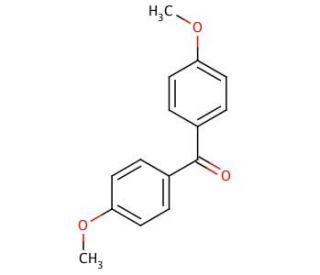

4,4′-Dimethoxybenzophenone (CAS 90-96-0)
QUICK LINKS
4,4′-Dimethoxybenzophenone, known as bisphenol A dimethacrylate, serves as a significant monomer in the synthesis of polymers, particularly acrylic and methacrylate polymers. This compound exists as a white crystalline solid and exhibits solubility in carbon disulfide, alcohol, benzene, and chloroform. 4,4′-Dimethoxybenzophenone showcases its versatility through a broad array of applications, including polymer synthesis, adhesive and coating production, printing ink formulation, and the manufacturing of optical materials. Scientists have extensively employed 4,4′-Dimethoxybenzophenone as a model compound in various scientific studies. It serves as useful in investigating the photochemical and photophysical properties of organic molecules, as well as studying the reactivity of organic molecules under light-induced conditions. Furthermore, researchers utilize it to explore the impact of light on the structure and properties of polymer networks. It also aids in studying the interactions between organic molecules and metal ions when employed as a model compound. 4,4′-Dimethoxybenzophenone exhibits photolability, signifying its ability to undergo a photochemical reaction upon exposure to light. The absorption of light initiates this reaction, leading to the excitation and rearrangement of electrons within the molecule. This rearrangement subsequently results in the formation of reactive intermediates that can engage in reactions with other molecules or undergo further transformations.
4,4′-Dimethoxybenzophenone (CAS 90-96-0) References
- Studies directed to the total synthesis of ET 743 and analogues thereof: an expeditious route to the ABFGH subunit. | Zhou, B., et al. 2002. Org Lett. 4: 43-6. PMID: 11772086
- An antenna triplet sensitiser for 1-acyl-7-nitroindolines improves the efficiency of carboxylic acid photorelease. | Papageorgiou, G., et al. 2004. Photochem Photobiol Sci. 3: 366-73. PMID: 15052365
- Forward (singlet-singlet) and backward (triplet-triplet) energy transfer in a dendrimer with peripheral naphthalene units and a benzophenone core. | Bergamini, G., et al. 2004. Photochem Photobiol Sci. 3: 898-905. PMID: 15346193
- Catalytic enantioselective reactions driven by photoinduced electron transfer. | Bauer, A., et al. 2005. Nature. 436: 1139-40. PMID: 16121176
- Dual electron transfer pathways from 4,4'-dimethoxybenzophenone ketyl radical in the excited state to parent molecule in the ground state. | Sakamoto, M., et al. 2005. J Phys Chem A. 109: 6830-5. PMID: 16834038
- Rapid synthesis of 4-benzylidene and 4-[bis-(4-methoxyphenyl)-methylene-2-substituted phenyl-benzopyrans as potential selective estrogen receptor modulators (SERMs) using McMurry coupling reaction. | Gupta, A., et al. 2006. Bioorg Med Chem Lett. 16: 6006-12. PMID: 16979337
- Convenient one-pot synthesis of 2,2-bis-(4-hydroxyphenyl)-cyclopentanone. | Seo, JW., et al. 2008. J Org Chem. 73: 715-8. PMID: 18088140
- Experimental and theoretical studies on the mechanism of photochemical hydrogen transfer from 2-aminobenzimidazole to nπ* and ππ* aromatic ketones. | Jornet, D., et al. 2010. J Phys Chem B. 114: 11920-6. PMID: 20735030
- Photobehavior of mixed nπ*/ππ* triplets: simultaneous detection of the two transients, solvent-dependent hydrogen abstraction, and reequilibration upon protein binding. | Jornet, D., et al. 2011. J Phys Chem B. 115: 10768-74. PMID: 21790173
- Microphotochemistry: 4,4'-Dimethoxybenzophenone mediated photodecarboxylation reactions involving phthalimides. | Shvydkiv, O., et al. 2011. Beilstein J Org Chem. 7: 1055-63. PMID: 21915208
- Fast Photoinduced Large Deformation of Colloidal Spheres from a Novel 4-arm Azobenzene Compound. | Wang, J., et al. 2015. ACS Appl Mater Interfaces. 7: 16889-95. PMID: 26168368
- G2/M Cell Cycle Arrest and Tumor Selective Apoptosis of Acute Leukemia Cells by a Promising Benzophenone Thiosemicarbazone Compound. | Cabrera, M., et al. 2015. PLoS One. 10: e0136878. PMID: 26360247
- Unexpected reactivity of an alkylaluminum complex of a non-innocent 1,2-bis[(2,6-diisopropylphenyl)imino]acenaphthene ligand (dpp-bian). | Moskalev, MV., et al. 2016. Dalton Trans. 45: 15872-15878. PMID: 27301590
- Synthesis of Glycosyl Fluorides by Photochemical Fluorination with Sulfur(VI) Hexafluoride. | Kim, S., et al. 2021. Org Lett. 23: 190-194. PMID: 33354969
- Flow photolysis of aryldiazoacetates leading to dihydrobenzofurans via intramolecular C-H insertion. | O'Callaghan, KS., et al. 2023. Org Biomol Chem. 21: 4770-4780. PMID: 37248769
Ordering Information
| Product Name | Catalog # | UNIT | Price | Qty | FAVORITES | |
4,4′-Dimethoxybenzophenone, 25 g | sc-233039 | 25 g | $74.00 |