
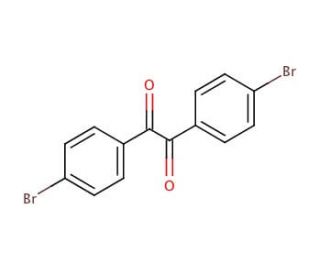

Molecular structure of 4,4′-Dibromobenzil, CAS Number: 35578-47-3
4,4′-Dibromobenzil (CAS 35578-47-3)
CAS Number:
35578-47-3
Molecular Weight:
368.02
Molecular Formula:
C14H8Br2O2
For Research Use Only. Not Intended for Diagnostic or Therapeutic Use.
* Refer to Certificate of Analysis for lot specific data.
QUICK LINKS
Ordering Information
Description
Technical Information
Safety Information
SDS & Certificate of Analysis
4,4′-Dibromobenzil (4,4′-DBB) is a member of the dibromobenzenes family, serving as a valuable synthetic compound. Scientific research relies significantly on the versatile properties of 4,4′-Dibromobenzil (4,4′-DBB). It plays a role in investigating the structure and properties of organic compounds. Additionally, 4,4′-Dibromobenzil finds application in the synthesis of heterocyclic compounds and the development of novel catalysts. While the full mechanism of action of 4,4′-Dibromobenzil remains unclear, it is believed to function as an inhibitor of cyclooxygenase enzymes.
4,4′-Dibromobenzil (CAS 35578-47-3) References
- Simultaneous irradiation of ultrasound and UV light. Ultrasonic acceleration of the photochemical disappearance of 4,4'-dihalogenated benzils in 1,4-dioxane. | Sohmiya, H., et al. 2001. Ultrason Sonochem. 8: 7-10. PMID: 11105316
- Identification and characterization of novel benzil (diphenylethane-1,2-dione) analogues as inhibitors of mammalian carboxylesterases. | Wadkins, RM., et al. 2005. J Med Chem. 48: 2906-15. PMID: 15828829
- Photochemical control of reversible encapsulation. | Dube, H., et al. 2010. Angew Chem Int Ed Engl. 49: 3192-5. PMID: 20309989
- A fluorescent, shape-persistent dendritic host with photoswitchable guest encapsulation and intramolecular energy transfer. | Nguyen, TT., et al. 2011. J Am Chem Soc. 133: 11194-204. PMID: 21682280
- Novel quinoxaline-based organic sensitizers for dye-sensitized solar cells. | Chang, DW., et al. 2011. Org Lett. 13: 3880-3. PMID: 21702514
- Reversibly expanded encapsulation complexes. | Ajami, D. and Rebek, J. 2012. Top Curr Chem. 319: 57-78. PMID: 22048687
- Selective guest exchange in encapsulation complexes using light of different wavelenghts. | Dube, H. and Rebek, J. 2012. Angew Chem Int Ed Engl. 51: 3207-10. PMID: 22337589
- Unexpected reactivity of diaryl α-diketones with thiazolium carbenes: discovery of a novel multicomponent reaction for the facile synthesis of 1,4-thiazin-3-ones. | Bertolasi, V., et al. 2012. Org Biomol Chem. 10: 6579-86. PMID: 22766681
- Photophysics Applied to Cavitands and Capsules. | Berryman, OB., et al. 2011. Isr J Chem. 51: 700-709. PMID: 24009399
- Self-assembly of Metallamacrocycles Employing a New Benzil-based Organometallic Bisplatinum(II) Acceptor. | Roy, B., et al. 2015. Chimia (Aarau). 69: 541-6. PMID: 26507762
- Modular Approaches to Diversified Soft Lewis Basic Complexants through Suzuki-Miyaura Cross-Coupling of Bromoheteroarenes with Organotrifluoroborates. | Chin, AL. and Carrick, JD. 2016. J Org Chem. 81: 1106-15. PMID: 26751755
- A Porous Organic Poly(triphenylimidazole) Decorated with Palladium Nanoparticles for the Cyanation of Aryl Iodides. | Yu, H., et al. 2018. Chem Asian J. 13: 2708-2713. PMID: 29964363
- An iminodibenzyl-quinoxaline-iminodibenzyl scaffold as a mechanochromic and dual emitter: donor and bridge effects on optical properties. | Pashazadeh, R., et al. 2018. Chem Commun (Camb). 54: 13857-13860. PMID: 30474098
- Controllably realizing elastic/plastic bending based on a room-temperature phosphorescent waveguiding organic crystal. | Liu, H., et al. 2019. Chem Sci. 10: 227-232. PMID: 30713634
- Aggregation-induced emission luminogen based molecularly imprinted ratiometric fluorescence sensor for the detection of Rhodamine 6G in food samples. | Li, Y., et al. 2019. Food Chem. 287: 55-60. PMID: 30857718
Ordering Information
| Product Name | Catalog # | UNIT | Price | Qty | FAVORITES | |
4,4′-Dibromobenzil, 10 g | sc-233030 | 10 g | $54.00 |