
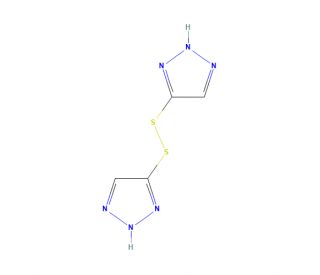

4,4′-Di(1,2,3-triazolyl) Disulfide (CAS 6440-09-1)
QUICK LINKS
4,4′-Di(1,2,3-triazolyl) Disulfide is a compound of interest in chemical research, particularly in the areas of organic synthesis and materials science. It is explored for its potential as a building block in the construction of complex molecules through click chemistry, a method known for its efficiency in joining small units together using triazole rings as connectors. Researchers leverage the disulfide bond in 4,4′-Di(1,2,3-triazolyl) Disulfide for studies on redox chemistry and the reversible cleavage and reformation of disulfide bridges, which is significant in the design of responsive materials. The compound is also studied for its applications in the synthesis of polymers and dendrimers, where the triazole and disulfide functionalities can impart unique properties such as self-healing or environmental responsiveness. Additionally, its role in the development of sensors and switches is of interest due to the modifiable nature of the disulfide bond in response to external stimuli. The compound′s utility in facilitating the formation of supramolecular structures is another area of research focus, contributing to advancements in the field of molecular engineering.
4,4′-Di(1,2,3-triazolyl) Disulfide (CAS 6440-09-1) References
- A Triazole Disulfide Compound Increases the Affinity of Hemoglobin for Oxygen and Reduces the Sickling of Human Sickle Cells. | Nakagawa, A., et al. 2018. Mol Pharm. 15: 1954-1963. PMID: 29634905
- Antisickling Drugs Targeting βCys93 Reduce Iron Oxidation and Oxidative Changes in Sickle Cell Hemoglobin. | Kassa, T., et al. 2019. Front Physiol. 10: 931. PMID: 31396101
- βCysteine 93 in human hemoglobin: a gateway to oxidative stability in health and disease. | Alayash, AI. 2021. Lab Invest. 101: 4-11. PMID: 32980855
- Antioxidant and anti-sickling activity of glucal-based triazoles compounds - An in vitro and in silico study. | Vieira Veloso, R., et al. 2021. Bioorg Chem. 109: 104709. PMID: 33636439
- Caffeic acid: an antioxidant with novel antisickling properties. | Kassa, T., et al. 2021. FEBS Open Bio. 11: 3293-3303. PMID: 34510823
- Functionalized p-dopants as self-assembled monolayers for enhanced charge carrier injection in organic electronic devices | S. Nicht, H. Kleemann, A. Fischer, K. Leo, B. Lüssem. 2014. Organic Electronics. 15: 654-660.
- Development of a Triazolyldisulfide Compound That Increases the Affinity of Hemoglobin for Oxygen and Reduces Hypoxic Sickling of Sickle Cells | Akito Nakagawa PhD * 1, Ferrari Michele MD * 1, Chen Liu PhD * 1, Lorenzo Berra MD * 1, Elizabeth S. Klings MD 2, Martin K. Safo PhD 3, Donald B. Bloch MD * 1 4, Osheiza Abdulmalik DVM, MS 5, Warren M. Zapol MD * 1. 2016. Blood. 128: 3642.
Ordering Information
| Product Name | Catalog # | UNIT | Price | Qty | FAVORITES | |
4,4′-Di(1,2,3-triazolyl) Disulfide, 1 g | sc-489745 | 1 g | $362.00 |