
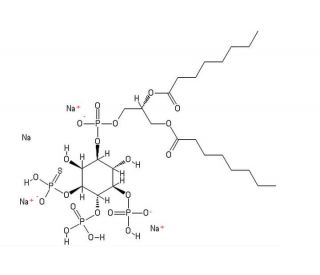

3-PT-PtdIns (3,4,5)-P3 (1,2-dioctanoyl), sodium salt
QUICK LINKS
3-PT-PtdIns-(3,4,5)-P3 (1,2-dioctanoyl), sodium salt, is a compound extensively studied in scientific research for its role in intracellular signaling pathways. This chemical functions as a potent modulator of phosphoinositide metabolism, particularly targeting the phosphatidylinositol 3-kinase (PI3K) signaling pathway. PI3Ks are enzymes involved in cellular processes such as cell growth, proliferation, and survival. 3-PT-PtdIns-(3,4,5)-P3 interacts with PI3Ks, leading to the phosphorylation of phosphatidylinositol 4,5-bisphosphate (PIP2) to generate phosphatidylinositol 3,4,5-trisphosphate (PIP3). PIP3 serves as a crucial secondary messenger, recruiting proteins with pleckstrin homology (PH) domains to the plasma membrane, including Akt (protein kinase B), which subsequently initiates downstream signaling cascades regulating various cellular functions. Research has shown that 3-PT-PtdIns-(3,4,5)-P3, by modulating PI3K signaling, plays a pivotal role in diverse physiological processes such as cell growth, proliferation, metabolism, and cytoskeletal rearrangement. Furthermore, investigations into the aberrant regulation of PI3K signaling by 3-PT-PtdIns-(3,4,5)-P3 have provided insights into its involvement in the pathogenesis of numerous diseases, including cancer, diabetes, and cardiovascular disorders. This compound serves as a valuable tool in deciphering the complex mechanisms of PI3K signaling and exploring its potential in various pathological conditions.
3-PT-PtdIns (3,4,5)-P3 (1,2-dioctanoyl), sodium salt References
- The phosphatidylinositol 3-Kinase AKT pathway in human cancer. | Vivanco, I. and Sawyers, CL. 2002. Nat Rev Cancer. 2: 489-501. PMID: 12094235
- Inositol phosphate biochemistry. | Majerus, PW. 1992. Annu Rev Biochem. 61: 225-50. PMID: 1323235
- Synthesis and biological activity of PTEN-resistant analogues of phosphatidylinositol 3,4,5-trisphosphate. | Zhang, H., et al. 2006. J Am Chem Soc. 128: 16464-5. PMID: 17177371
- Regulation of phosphoinositide phospholipases by hormones, neurotransmitters, and other agonists linked to G proteins. | Exton, JH. 1996. Annu Rev Pharmacol Toxicol. 36: 481-509. PMID: 8725399
Ordering Information
| Product Name | Catalog # | UNIT | Price | Qty | FAVORITES | |
3-PT-PtdIns (3,4,5)-P3 (1,2-dioctanoyl), sodium salt, 25 µg | sc-220884 | 25 µg | $96.00 | |||
3-PT-PtdIns (3,4,5)-P3 (1,2-dioctanoyl), sodium salt, 50 µg | sc-220884A | 50 µg | $182.00 |