
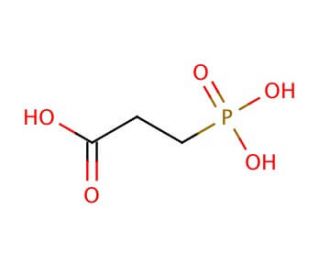

3-Phosphonopropionic acid (CAS 5962-42-5)
QUICK LINKS
3-Phosphonopropionic acid (3-PPA) is a highly versatile compound widely employed in numerous scientific applications, particularly in the realm of biochemical research. As an organophosphonate with structural similarities to carboxylic acids, 3-Phosphonopropionic acid can be synthesized using various methods, making it adaptable for diverse purposes. In scientific research, 3-Phosphonopropionic acid exhibits remarkable versatility, finding use in an array of biochemical experiments. These encompass investigations related to enzyme inhibition, protein-protein interactions, and cell signaling. Additionally, its role extends to the exploration of protein, nucleic acid, carbohydrate, and lipid structures and functions. Functioning as an organophosphonate, 3-PPA acts as an inhibitor of enzymes and proteins by binding to their active sites, impeding their activity. Furthermore, it can also interact with the active sites of nucleic acids, leading to the suppression of their functions. This inhibition approach offers valuable insights into the structures and functions of enzymes, proteins, and nucleic acids. 3-Phosphonopropionic acid serves as an indispensable tool in scientific research, enabling researchers to unlock a myriad of possibilities in understanding complex biochemical processes.
3-Phosphonopropionic acid (CAS 5962-42-5) References
- Effects of self-assembly of 3-phosphonopropionic acid, 3-aminopropyltrimethoxysilane and dopamine on the corrosion behaviors and biocompatibility of a magnesium alloy. | Pan, CJ., et al. 2016. Mater Sci Eng C Mater Biol Appl. 67: 132-143. PMID: 27287107
- Xylanase immobilization on magnetite and magnetite core/shell nanocomposites using two different flexible alkyl length organophosphonates: Linker length and shell effect on enzyme catalytic activity. | Singh, V., et al. 2018. Int J Biol Macromol. 115: 590-599. PMID: 29684449
- An Ion-Exchangeable MOF with Reversible Dehydration and Dynamic Structural Behavior (NH4)2 [Zn2 (O3 PCH2 CH2 COO)2 ]⋅5 H2 O (BIRM-1). | Zhao, C., et al. 2019. Chemistry. 25: 13865-13868. PMID: 31486553
- Protolysis and Complex Formation of Organophosphorus Compounds-Characterization by NMR-Controlled Titrations. | Hägele, G. 2019. Molecules. 24: PMID: 31492010
- Organophosphonate functionalized Au/Si@Fe3O4: Versatile carrier for enzyme immobilization. | Kaul, S., et al. 2020. Methods Enzymol. 630: 199-214. PMID: 31931986
- Trastuzumab Conjugated Superparamagnetic Iron Oxide Nanoparticles Labeled with 225Ac as a Perspective Tool for Combined α-Radioimmunotherapy and Magnetic Hyperthermia of HER2-Positive Breast Cancer. | Cędrowska, E., et al. 2020. Molecules. 25: PMID: 32106568
- Trastuzumab Modified Barium Ferrite Magnetic Nanoparticles Labeled with Radium-223: A New Potential Radiobioconjugate for Alpha Radioimmunotherapy. | Gawęda, W., et al. 2020. Nanomaterials (Basel). 10: PMID: 33092037
- Ultrasensitive detection of interleukin 1α using 3-phosphonopropionic acid modified FTO surface as an effective platform for disposable biosensor fabrication. | Aydın, EB. and Sezgintürk, MK. 2021. Bioelectrochemistry. 138: 107698. PMID: 33254051
- Editorial: Phosphonate Chemistry in Drug Design and Development. | Turhanen, PA., et al. 2021. Front Chem. 9: 695128. PMID: 33996774
- Modification of Amorphous Mesoporous Zirconia Nanoparticles with Bisphosphonic Acids: A Straightforward Approach for Tailoring the Surface Properties of the Nanoparticles. | Hossain, K., et al. 2021. Chemistry. 27: 17941-17951. PMID: 34705317
- OBP-functionalized/hybrid superparamagnetic nanoparticles for Candida albicans treatment. | Riboni, N., et al. 2021. RSC Adv. 11: 11256-11265. PMID: 35423627
- Magnetic Nanoparticles as Effective Heavy Ion Adsorbers in Natural Samples. | Klekotka, U., et al. 2022. Sensors (Basel). 22: PMID: 35590985
- In Situ FTIR Spectroscopy for Scanning Accessible Active Sites in Defect-Engineered UiO-66. | Butova, VV., et al. 2023. Nanomaterials (Basel). 13: PMID: 37242091
Ordering Information
| Product Name | Catalog # | UNIT | Price | Qty | FAVORITES | |
3-Phosphonopropionic acid, 5 g | sc-231915 | 5 g | $70.00 |