
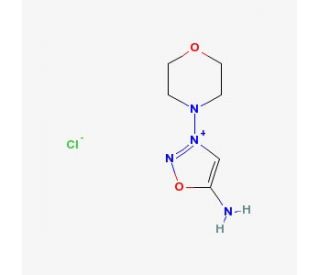

3-Morpholinosydnonimine (CAS 16142-27-1)
Produktreferenzen ansehen (10)
Direktverknüpfungen
3-Morpholinosydnonimin (SIN-1) ist ein Metabolit von Molsidomin (sc-200337), der gezeigt hat, dass er in Gegenwart von Sauerstoff spontan in Lösung zerfällt. Diese Reaktion mit 3-Morpholinosydnonimin setzt Stickstoffmonoxid (NO) und ein Superoxidanion frei, das unter physiologischen Bedingungen zu Peroxynitrit reagiert. 3-Morpholinosydnonimin ist ein potentes Vasodilatans, ein Hemmstoff der Blutplättchenaggregation und ein allgemeiner Cystein-Protease-Inhibitor. 3-Morpholinosydnonimin hat signifikante schützende Effekte bei der Myokardischämie-Reperfusion gezeigt. Einige der Wirkungen von 3-Morpholinosydnonimin können durch Nitroglycerin-induzierte Toleranz abgeschwächt werden.
3-Morpholinosydnonimine (CAS 16142-27-1) Literaturhinweise
- Hemmung der Cysteinprotease-Aktivität durch NO-Donatoren. | Ascenzi, P., et al. 2001. Curr Protein Pept Sci. 2: 137-53. PMID: 12370021
- Metallothionein schwächt den durch 3-Morpholinosydnonimin (SIN-1) ausgelösten oxidativen Stress in dopaminergen Neuronen ab. | Sharma, SK. and Ebadi, M. 2003. Antioxid Redox Signal. 5: 251-64. PMID: 12880480
- Erzeugung von Hydroxylradikalen durch die gleichzeitige Bildung von Superoxid und Stickstoffoxid. | Hogg, N., et al. 1992. Biochem J. 281 (Pt 2): 419-24. PMID: 1310595
- Schützende Wirkung von 1-methylierten Beta-Carbolinen gegen 3-Morpholinosydnonimin-induzierte mitochondriale Schäden und Verlust der Zelllebensfähigkeit in PC12-Zellen. | Choi, WT., et al. 2004. Neurochem Res. 29: 1807-16. PMID: 15532535
- Kardioprotektion und Abschwächung der endothelialen Dysfunktion durch organische Stickoxid-Donatoren bei Myokardischämie-Reperfusion. | Siegfried, MR., et al. 1992. J Pharmacol Exp Ther. 260: 668-75. PMID: 1738117
- Der Peroxynitrit-Donor 3-Morpholinosydnonimin induziert reversible Veränderungen der elektrophysiologischen Eigenschaften von Neuronen des Meerschweinchen-Rückenmarks. | Ashki, N., et al. 2008. Neuroscience. 156: 107-17. PMID: 18662749
- 3-Morpholinosydnonimin ist an der Abschwächung der Neointimabildung durch Hemmung der durch Annexin A2 vermittelten Migration der glatten Gefäßmuskelzellen beteiligt. | Won, KJ., et al. 2011. Proteomics. 11: 193-201. PMID: 21204247
- Der Peroxynitrit-Donor 3-Morpholinosydnonimin aktiviert Nrf2 und die UPR, was zu einer zytoprotektiven Reaktion in Endothelzellen führt. | Mattart, L., et al. 2012. Cell Signal. 24: 199-213. PMID: 21945407
- Nitroglycerin-induzierte Toleranz betrifft mehrere Stellen in der Biokonversionskaskade von organischem Nitrat. | Henry, PJ., et al. 1989. J Pharmacol Exp Ther. 248: 762-8. PMID: 2563771
- 3-Morpholinosydnonimin (SIN-1)-induzierter oxidativer Stress führt zu Nekrose in hypertrophen Chondrozyten in vitro. | He, Y., et al. 2018. Biomed Pharmacother. 106: 1696-1704. PMID: 30119244
- Hemmung der Thrombozytenaggregation und Stimulierung der Guanylatzyklase durch ein antianginöses Mittel, Molsidomin, und seine Metaboliten. | Nishikawa, M., et al. 1982. J Pharmacol Exp Ther. 220: 183-90. PMID: 6118429
- Erhöhte Zytotoxizität von 3-Morpholinosydnonimin für HepG2-Zellen in Gegenwart von Superoxiddismutase. Die Rolle von Wasserstoffperoxid und Eisen. | Gergel, D., et al. 1995. J Biol Chem. 270: 20922-9. PMID: 7673115
- Spin-Trapping-Studien zur Zersetzung von Peroxynitrit und zur Autooxidation von 3-Morpholinosydnonimin-N-Ethylcarbamid: direkter Nachweis für die metallunabhängige Bildung von freien Radikal-Zwischenprodukten. | Augusto, O., et al. 1994. Arch Biochem Biophys. 310: 118-25. PMID: 8161194
- Ein redoxbasierter Mechanismus für die neuroprotektiven und neurodestruktiven Wirkungen von Stickstoffmonoxid und verwandten Nitroso-Verbindungen. | Lipton, SA., et al. 1993. Nature. 364: 626-32. PMID: 8394509
- Die Aktivierung der löslichen Guanylylzyklase durch den Nitrovasodilator 3-Morpholinosydnonimin ist mit der Bildung von S-Nitrosoglutathion verbunden. | Schrammel, A., et al. 1998. Mol Pharmacol. 54: 207-12. PMID: 9658207
Bestellinformation
| Produkt | Katalog # | EINHEIT | Preis | ANZAHL | Favoriten | |
3-Morpholinosydnonimine, 20 mg | sc-200339 | 20 mg | $89.00 | |||
3-Morpholinosydnonimine, 100 mg | sc-200339A | 100 mg | $369.00 |