
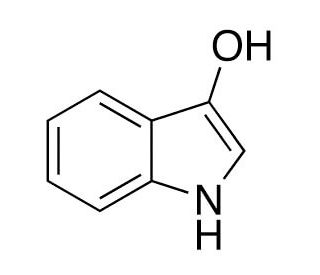

3-Hydroxyindole (CAS 480-93-3)
QUICK LINKS
3-Hydroxyindole is a research chemical with applications in the fields of neurochemistry and environmental science. It acts as a substrate in enzymatic studies to elucidate the pathways of tryptophan metabolism, where indoleamine 2,3-dioxygenase (IDO) enzymes convert tryptophan into kynurenine derivatives, a process with implications in understanding neurodegenerative conditions. Environmental scientists use it to investigate the microbial breakdown of indolic compounds, which are common in soil ecosystems, to assess the fate of such organic pollutants. Furthermore, it plays a role in photophysical studies due to its fluorescent properties, enabling researchers to probe the behavior of indolic structures under light excitation.
3-Hydroxyindole (CAS 480-93-3) References
- Formation of indigo by recombinant mammalian cytochrome P450. | Gillam, EM., et al. 1999. Biochem Biophys Res Commun. 265: 469-72. PMID: 10558891
- Sulfation of indoxyl by human and rat aryl (phenol) sulfotransferases to form indoxyl sulfate. | Banoglu, E. and King, RS. 2002. Eur J Drug Metab Pharmacokinet. 27: 135-40. PMID: 12064372
- Inhibition of amyloid fibril formation and cytotoxicity by hydroxyindole derivatives. | Cohen, T., et al. 2006. Biochemistry. 45: 4727-35. PMID: 16605241
- [Microbial biosynthesis and biotransformation of indigo and indigo-like pigments]. | Han, X., et al. 2008. Sheng Wu Gong Cheng Xue Bao. 24: 921-6. PMID: 18807970
- Consumption of pasteurized human lysozyme transgenic goats' milk alters serum metabolite profile in young pigs. | Brundige, DR., et al. 2010. Transgenic Res. 19: 563-74. PMID: 19847666
- Antioxidant activity of an unusual 3-hydroxyindole derivative isolated from fruits of Aristotelia chilensis (Molina) Stuntz. | Céspedes, CL., et al. 2009. Z Naturforsch C J Biosci. 64: 759-62. PMID: 19957448
- A labeled substrate approach to discovery of biocatalytic reactions: a proof of concept transformation with N-methylindole. | Rogers, JL. and MacMillan, JB. 2012. J Am Chem Soc. 134: 12378-81. PMID: 22809085
- New pathway for the biodegradation of indole in Aspergillus niger. | Kamath, AV. and Vaidyanathan, CS. 1990. Appl Environ Microbiol. 56: 275-80. PMID: 2310183
Ordering Information
| Product Name | Catalog # | UNIT | Price | Qty | FAVORITES | |
3-Hydroxyindole, 100 mg | sc-490580 | 100 mg | $426.00 | |||
3-Hydroxyindole, 250 mg | sc-490580A | 250 mg | $750.00 | |||
3-Hydroxyindole, 1 g | sc-490580B | 1 g | $1800.00 |