
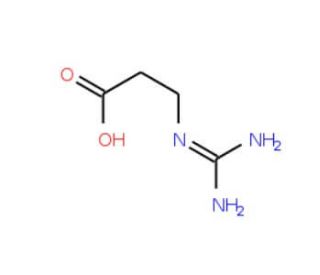

Molecular structure of 3-Guanidinopropionic acid, CAS Number: 353-09-3
3-Guanidinopropionic acid (CAS 353-09-3)
Alternate Names:
β-Guanidinopropionic acid
Application:
3-Guanidinopropionic acid is a creatine and GABA analog found in mammalian blood plasma and erythrocytes
CAS Number:
353-09-3
Purity:
≥98%
Molecular Weight:
131.13
Molecular Formula:
C4H9N3O2
For Research Use Only. Not Intended for Diagnostic or Therapeutic Use.
* Refer to Certificate of Analysis for lot specific data.
QUICK LINKS
Ordering Information
Description
Technical Information
Safety Information
SDS & Certificate of Analysis
Analogue of creatine (1), (2); Analogue of GABA (3)
3-Guanidinopropionic acid (CAS 353-09-3) References
1. R.P. Shields, C. Whittehair Can. J. Biochem. 51, 1046, (1973) 2. D. Holtzman et al. Brain Res. 483, 68, (1989) 3. Z. Liron et al. Life Sci. 36, 321, (1985)Inhibitor of:
creatine kinase-B, GAMT, Gatm, PEPCK-M, SLC6A8, and SNAT5.Activator of:
MRPL28.Ordering Information
| Product Name | Catalog # | UNIT | Price | Qty | FAVORITES | |
3-Guanidinopropionic acid, 1 g | sc-254485 | 1 g | $56.00 | |||
3-Guanidinopropionic acid, 5 g | sc-254485A | 5 g | $197.00 |