
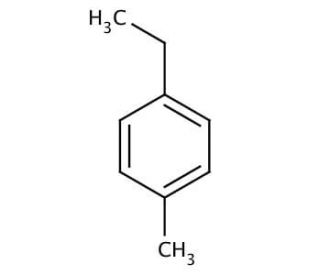

3-Ethyltoluene (CAS 620-14-4)
QUICK LINKS
3-Ethyltoluene is frequently used in research focused on organic synthesis and hydrocarbon processing. This compound serves as a model to study the behavior and transformation of alkylbenzenes under various chemical reaction conditions, such as oxidation or halogenation. Researchers utilize 3-Ethyltoluene to explore its reactivity and stability, which are essential for developing new synthetic routes in organic chemistry. Additionally, it is employed in studies related to the environmental fate of volatile organic compounds, aiding in understanding their degradation pathways and persistence in the environment. 3-Ethyltoluene also plays a role in the development of catalytic systems that aim to improve the efficiency and selectivity of chemical transformations involving aromatic hydrocarbons.
3-Ethyltoluene (CAS 620-14-4) References
- Simultaneous analysis of 22 volatile organic compounds in cigarette smoke using gas sampling bags for high-throughput solid-phase microextraction. | Sampson, MM., et al. 2014. Anal Chem. 86: 7088-95. PMID: 24933649
- Comparative inhalation toxicity of ethyltoluene isomers in rats and mice. | Roberts, GK., et al. 2017. Inhal Toxicol. 29: 577-585. PMID: 29374990
- Emission fluxes of styrene monomers and other chemicals for products containing expanded polystyrene beads. | Iizuka, A., et al. 2020. PLoS One. 15: e0239458. PMID: 33002057
- Overcoming bacterial physical defenses with molecule-like ultrasmall antimicrobial gold nanoclusters. | Zheng, K., et al. 2021. Bioact Mater. 6: 941-950. PMID: 33102937
- Py-FTIR-GC/MS Analysis of Volatile Products of Automobile Shredder Residue Pyrolysis. | Yang, B. and Chen, M. 2020. Polymers (Basel). 12: PMID: 33217995
- Genomic analysis reveals the potential for hydrocarbon degradation of Rhodopirellula sp. MGV isolated from a polluted Brazilian mangrove. | de Araujo, JE., et al. 2021. Braz J Microbiol. 52: 1397-1404. PMID: 33852152
- Modulating the stacking modes of nanosized metal-organic frameworks by morphology engineering for isomer separation. | Xu, M., et al. 2021. Chem Sci. 12: 4104-4110. PMID: 34163681
- Identifying volatile in vitro biomarkers for oral bacteria with proton-transfer-reaction mass spectrometry and gas chromatography-mass spectrometry. | Roslund, K., et al. 2021. Sci Rep. 11: 16897. PMID: 34413397
- Natural attenuation characteristics and comprehensive toxicity changes of C9 aromatics under simulated marine conditions. | Li, D., et al. 2021. J Environ Sci (China). 109: 26-35. PMID: 34607671
- Identification and Evaluation of Hazardous Pyrolysates in Bio-Based Rigid Polyurethane-Polyisocyanurate Foam Smoke. | Reinerte, S., et al. 2021. Polymers (Basel). 13: PMID: 34641023
- Whole genome sequencing and comparative genomic analyses of Planococcus alpniumensis MSAK28401T, a new species isolated from Antarctic krill. | Wang, Y., et al. 2021. BMC Microbiol. 21: 288. PMID: 34686131
- Intermediates formed during natural attenuation of C9 aromatics under simulated marine conditions: Identification, transformation pathway, and toxicity to microalgae. | Zhang, B., et al. 2022. Environ Res. 206: 112558. PMID: 34932976
- Exhaled metabolic markers and relevant dysregulated pathways of lung cancer: a pilot study. | Zou, Y., et al. 2022. Ann Med. 54: 790-802. PMID: 35261323
- Active and passive adsorption of 47 trace atmospheric volatile organic compounds onto carbon nanotubes. | Wong, GKS. and Webster, RD. 2021. RSC Adv. 11: 29913-29919. PMID: 35480271
- Antioxidant and antimicrobial potential of two extracts from Capparis spinosa L. and Rumex nervosus and molecular docking investigation of selected major compounds. | AlMousa, LA., et al. 2022. Saudi J Biol Sci. 29: 103346. PMID: 35784613
Ordering Information
| Product Name | Catalog # | UNIT | Price | Qty | FAVORITES | |
3-Ethyltoluene, 10 g | sc-238543 | 10 g | $134.00 |