
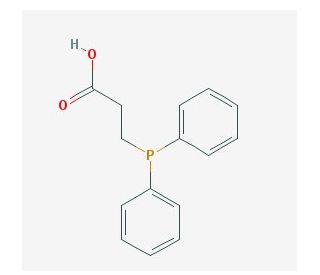

Molecular structure of 3-(Diphenylphosphino)propionic acid, CAS Number: 2848-01-3
3-(Diphenylphosphino)propionic acid (CAS 2848-01-3)
Alternate Names:
(2-Carboxyethyl)diphenylphosphine
CAS Number:
2848-01-3
Purity:
≥97%
Molecular Weight:
258.25
Molecular Formula:
C15H15O2P
For Research Use Only. Not Intended for Diagnostic or Therapeutic Use.
* Refer to Certificate of Analysis for lot specific data.
QUICK LINKS
Ordering Information
Description
Technical Information
Safety Information
SDS & Certificate of Analysis
3-(Diphenylphosphino)propionic acid is a chemical compound that consists of a propionic acid core with a diphenylphosphino group attached. It is used as a ligand in various catalytic reactions, particularly in transition metal-catalyzed processes. The diphenylphosphino group enhances the reactivity and selectivity of the catalyst, making it useful in organic synthesis. This compound finds applications in areas such as pharmaceuticals, materials science, and fine chemical synthesis.
3-(Diphenylphosphino)propionic acid (CAS 2848-01-3) References
- Antimalarial, antimicrobial, cytotoxic, DNA interaction and SOD like activities of tetrahedral copper(II) complexes. | Mehta, JV., et al. 2015. Spectrochim Acta A Mol Biomol Spectrosc. 136 Pt C: 1881-92. PMID: 25467683
- Biomimetic peptide-based models of [FeFe]-hydrogenases: utilization of phosphine-containing peptides. | Roy, S., et al. 2015. Dalton Trans. 44: 14865-76. PMID: 26223293
- Size selectivity in antibiofilm activity of 3-(diphenylphosphino)propanoic acid coated gold nanomaterials against Gram-positive Staphylococcus aureus and Streptococcus mutans. | Ahmed, D., et al. 2017. AMB Express. 7: 210. PMID: 29164404
- The Use of Nanomedicine for Targeted Therapy against Bacterial Infections. | Masri, A., et al. 2019. Antibiotics (Basel). 8: PMID: 31835647
- A dimolybdenum paddlewheel as a building block for heteromultimetallic structures. | Knöfel, ND., et al. 2020. Dalton Trans. 49: 1513-1521. PMID: 31922175
- Fluorescent and Biocompatible Ruthenium-Coordinated Oligo(p-phenylenevinylene) Nanocatalysts for Transfer Hydrogenation in the Mitochondria of Living Cells. | Dai, N., et al. 2020. Chemistry. 26: 4489-4495. PMID: 32073730
- Design of a Functionalized Metal-Organic Framework System for Enhanced Targeted Delivery to Mitochondria. | Haddad, S., et al. 2020. J Am Chem Soc. 142: 6661-6674. PMID: 32182066
- Supramolecular Regulation of Catalytic Activity for an Amphiphilic Pyrene-Ruthenium Complex in Water. | Dai, N., et al. 2021. Chemistry. 27: 11567-11573. PMID: 34060163
- Nonanuclear zinc-gold [Zn3Au6] heterobimetallic complexes. | Yadav, R., et al. 2021. Dalton Trans. 50: 8558-8566. PMID: 34075990
- Shedding Light on DNA-Based Nanoprobes for Live-Cell MicroRNA Imaging. | Yang, F., et al. 2022. Small. 18: e2106281. PMID: 34854567
- Personalized, 3D- printed fracture fixation plates versus commonly used orthopedic implant materials- biomaterials characteristics and bacterial biofilm formation. | Mazurek-Popczyk, J., et al. 2022. Injury. 53: 938-946. PMID: 34949461
- New biologically active phosphonium salts based on 3-(diphenylphosphino)propionic acid and unsaturated amides | Yu. V. Bakhtiyarova, M. V. Morozov, S. R. Romanov, R. R. Minnullin, M. P. Shulaeva, O. K. Pozdeev, I. V. Galkina & V. I. Galkin. 2020. Russian Chemical Bulletin. 69: 1569–1572.
- Carboxylate Phosphabetaines Containing Chiral Carbon Atom: Synthesis and NMR Spectroscopy Data | S. R. Romanov, Yu. V. Bakhtiyarova, M. V. Morozov, F. Kh. Karataeva, V. V. Klochkov, I. V. Galkina & V. I. Galkin. 2021. Russian Journal of General Chemistry. 91: 1333–1341.
Ordering Information
| Product Name | Catalog # | UNIT | Price | Qty | FAVORITES | |
3-(Diphenylphosphino)propionic acid, 1 g | sc-231371 | 1 g | $95.00 |