
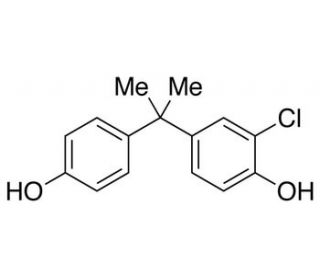

3-Chlorobisphenol A 的分子结构, CAS编号: 74192-35-1
3-Chlorobisphenol A (CAS 74192-35-1)
查看产品引用文献(2)
备用名:
2-Chloro-4-[1-(4-hydroxyphenyl)-1-methylethyl]phenol; 2-Chloro-4,4′-isopropylidenediphenol; Chlorobisphenol A
CAS号码:
74192-35-1
分子量:
262.73
分子式:
C15H15ClO2
仅供科研使用。不可用于诊断或治疗。
* 参考分析证明 大量特定数据 (包括水 含量).
快捷链接
订购信息
产品相关文献索引
描述
技术信息
安全信息
安全技术说明书和分析证明书
在实验应用中,3-氯双酚 A 可能会干扰内分泌。众所周知,它会与荷尔蒙受体(尤其是雌激素受体)相互作用,影响它们的正常功能。3-Chlorobisphenol A 可能会与雌激素受体结合,导致正常的激素信号途径受到破坏。据观察,3-氯双酚 A 会干扰与激素调节有关的基因表达,从而对细胞过程产生潜在影响。其作用机制包括改变雌激素受体的活性,从而对各种生物过程产生影响。在实验应用中,3-氯双酚 A 被用来研究其干扰内分泌功能的能力及其对细胞和分子过程的潜在影响。
3-Chlorobisphenol A (CAS 74192-35-1) 参考文献
- 利用慢病毒载体将甲状腺激素反应报告基因转导至爪蟾细胞系的特征。 | Sugiyama, S., et al. 2005. Gen Comp Endocrinol. 144: 270-9. PMID: 16102758
- 内分泌干扰物的非基因影响:酚类和氯化酚对雌激素磺基转移酶的抑制作用。 | Harris, RM., et al. 2005. Mol Cell Endocrinol. 244: 72-4. PMID: 16266779
- 氯化双酚 a 暴露于紫外线 B 后雌激素活性的变化和氯离子的释放。 | Mutou, Y., et al. 2006. Biol Pharm Bull. 29: 2116-9. PMID: 17015961
- 紫外线照射下氯化双酚 A 在 Jurkat 细胞中诱导细胞凋亡。 | Mutou, Y., et al. 2008. Toxicol In Vitro. 22: 864-72. PMID: 18280695
- 紫外线照射下的氯化双酚 A 会在人类皮肤细胞中产生磷酸化组蛋白 H2AX。 | Ibuki, Y., et al. 2008. Chem Res Toxicol. 21: 1770-6. PMID: 18729329
- 利用酵母双杂交试验评估卤代双酚 A 的甲状腺激素活性。 | Terasaki, M., et al. 2011. Chemosphere. 84: 1527-30. PMID: 21550628
- 紫外线照射下氯化双酚 A 的化学变化及其产物对 Jurkat 细胞的细胞毒性。 | Mutou, Y., et al. 2006. Environ Toxicol Pharmacol. 21: 283-9. PMID: 21783670
- 盐碱地表层水光溴化过程的新见解:水杨酸案例。 | Tamtam, F. and Chiron, S. 2012. Sci Total Environ. 435-436: 345-50. PMID: 22863810
- 人类接触双酚 A, 双酚 F 和氯化双酚 A 衍生物与甲状腺功能。 | Andrianou, XD., et al. 2016. PLoS One. 11: e0155237. PMID: 27783680
- 在重组酵母细胞试验中检测到的多种异种生物对组成型雄甾烷受体的激动作用。 | Kamata, R., et al. 2018. Toxicol In Vitro. 46: 335-349. PMID: 28927721
- 污水处理厂废水中双酚 A 氯化衍生物的形成和光降解增强。 | Wan, D., et al. 2020. Water Res. 184: 116002. PMID: 32682078
- 扩大沿海水域双酚的视野:中国珠江三角洲多种新型双酚 S 衍生物以及双酚 A 和双酚 A 类似物的出现, 分配和输入通量。 | Liang, X., et al. 2023. Environ Pollut. 322: 121194. PMID: 36738885
订购信息
| 产品名称 | 产品编号 | 规格 | 价格 | 数量 | 收藏夹 | |
3-Chlorobisphenol A, 5 mg | sc-206638 | 5 mg | $347.00 |