
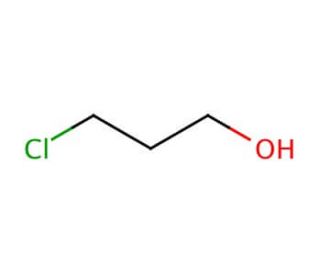

3-Chloro-1-propanol (CAS 627-30-5)
QUICK LINKS
3-Chloro-1-propanol functions as a reactant in organic synthesis. It acts as a nucleophile in substitution reactions, participating in the formation of new carbon-carbon or carbon-heteroatom bonds. 3-Chloro-1-propanol′s mechanism of action involves its ability to undergo nucleophilic substitution reactions, where the chlorine atom is replaced by another functional group, leading to the formation of different organic compounds. This process occurs through the interaction of the chlorine atom with other reagents or substrates, resulting in the modification of the chemical structure. In this way, 3-Chloro-1-propanol plays a role in the synthesis of diverse organic molecules, contributing to the development of new materials and compounds for various applications in research and development.
3-Chloro-1-propanol (CAS 627-30-5) References
- Stereocontrolled synthesis of cis-dibenzoquinolizine chlorofumarates: curare-like agents of ultrashort duration. | Kaldor, I., et al. 2001. J Org Chem. 66: 3495-501. PMID: 11348135
- Improved synthesis of three methyl-branched pheromone components produced by the female lichen moth. | Taguri, T., et al. 2010. Biosci Biotechnol Biochem. 74: 119-24. PMID: 20057134
- Simultaneous Determination of Genotoxic Impurities in Fudosteine Drugs by GC-MS. | Gooty, AR., et al. 2016. J Chromatogr Sci. 54: 1277-81. PMID: 27261527
- Evaluation of Maltose-Based Cationic Liposomes with Different Hydrophobic Tails for Plasmid DNA Delivery. | Li, B., et al. 2017. Molecules. 22: PMID: 28287501
- Synthesis and evaluation of L-arabinose-based cationic glycolipids as effective vectors for pDNA and siRNA in vitro. | Li, B., et al. 2017. PLoS One. 12: e0180276. PMID: 28672000
- Smart Nanoparticles for Selective Immobilization of Acid Phosphatases. | Nagy, F., et al. 2018. ChemCatChem. 10: 3490-3499. PMID: 30263083
- Direct Synthesis of Phosphonates and α-Amino-phosphonates from 1,3-Benzoxazines. | Salgado-Escobar, O., et al. 2019. Molecules. 24: PMID: 30650579
- Mechanistic insights into silk fibroin's adhesive properties via chemical functionalization of serine side chains. | Love, CJ., et al. 2019. ACS Biomater Sci Eng. 5: 5960-5967. PMID: 32529029
- Photo-responsive degradable hollow mesoporous organosilica nanoplatforms for drug delivery. | Fan, J., et al. 2020. J Nanobiotechnology. 18: 91. PMID: 32539777
- Influence of Material Properties on the Damage-Reporting and Self-Healing Performance of a Mechanically Active Dynamic Network Polymer in Coating Applications. | Son, DH., et al. 2021. Molecules. 26: PMID: 33922672
- Metal free synthesis of ethylene and propylene carbonate from alkylene halohydrin and CO2 at room temperature. | Khokarale, SG. and Mikkola, JP. 2019. RSC Adv. 9: 34023-34031. PMID: 35540956
- How differences in the molecular structure of monohydroxy alcohols affect the tendency to crystallization. | Łucak, K., et al. 2022. Eur Phys J E Soft Matter. 45: 64. PMID: 35917038
- Synthesis and Characterization of Quadrupolar-Hydrogen-Bonded Polymeric Ionic Liquids for Potential Self-Healing Electrolytes. | Li, C., et al. 2022. Polymers (Basel). 14: PMID: 36236037
- Polylactic-Containing Hyperbranched Polymers through the CuAAC Polymerization of Aromatic AB2 Monomers. | Pacini, A., et al. 2023. Int J Mol Sci. 24: PMID: 37108783
Ordering Information
| Product Name | Catalog # | UNIT | Price | Qty | FAVORITES | |
3-Chloro-1-propanol, 25 g | sc-238511 | 25 g | $33.00 | |||
3-Chloro-1-propanol, 100 g | sc-238511A | 100 g | $92.00 |