
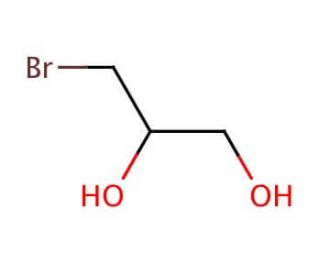

Molekülstruktur von 3-Bromo-1,2-propanediol, CAS-Nummer: 4704-77-2
3-Bromo-1,2-propanediol (CAS 4704-77-2)
Alternative Namen:
α-Glycerol bromohydrin
Anwendungen:
3-Bromo-1,2-propanediol ist ein Schutzgruppenreagenz für Carbonylfunktionen
CAS Nummer:
4704-77-2
Reinheit:
≥97%
Molekulargewicht:
154.99
Summenformel:
C3H7BrO2
Ergänzende Informationen:
Dieses Produkt wird als Gefahrgut eingestuft und unterliegt möglicherweise zusätzlichen Versandkosten.
Ausschließlich für Forschungszwecke. Nicht Geeignet für Verwendung in Diagnostik oder Therapie.
* Schauen Sie auf das Analysezertifikat (CoA), um die genauen Daten (inkl. Wassergehalt) Ihrer Produktionscharge (Lot) zu sehen.
Direktverknüpfungen
Bestellinformation
Beschreibung
Hintergrundinformationen
Sicherheitshinweis
SDS (SDB) & Analysenzertifikate
3-Bromo-1,2-Propandiol ist ein Brommethyläthylenketal, das unter neutralen Bedingungen zerlegt werden kann. Es kann als Schutzgruppenreagenz für Carbonylfunktionen dienen. Es fungiert als flexibles Grundelement, das die Erstellung von diversen Verbindungen wie Farbstoffen und Polymeren ermöglicht. Darüber hinaus findet es Anwendung als Reagenz in der Synthese verschiedener Derivate, einschließlich Peptiden und Kohlenhydraten. Diese farblose Flüssigkeit besitzt einen niedrigen Siedepunkt und ist in typischen organischen Lösungsmitteln löslich.
3-Bromo-1,2-propanediol (CAS 4704-77-2) Literaturhinweise
- Lösliche 3',6-substituierte Indirubine mit erhöhter Selektivität gegenüber Glykogensynthase-Kinase-3 verändern die zirkadiane Periode. | Vougogiannopoulou, K., et al. 2008. J Med Chem. 51: 6421-31. PMID: 18816110
- Die Radiosynthese des Tumorhypoxiemarkers [18F]TFMISO über O-[18F]Trifluorethylierung zeigt einen auffälligen Unterschied zwischen Trifluorethyltosylat und Iodid in der regiochemischen Reaktivität gegenüber Sauerstoffnukleophilen. | Suehiro, M., et al. 2011. Bioorg Med Chem. 19: 2287-97. PMID: 21398131
- Reinigung und Charakterisierung einer NADH-abhängigen Alkohol-Dehydrogenase aus Candida maris für die Synthese von optisch aktiven 1-(Pyridyl)ethanol-Derivaten. | Kawano, S., et al. 2011. Biosci Biotechnol Biochem. 75: 1055-60. PMID: 21670533
- Pseudomonas aeruginosa Cif definiert eine eigene Klasse von α/β-Epoxidhydrolasen, die ein His/Tyr-Ringöffnungspaar verwenden. | Bahl, CD. and Madden, DR. 2012. Protein Pept Lett. 19: 186-93. PMID: 21933119
- Epoxid-vermittelte differentielle Verpackung von Cif und anderen Virulenzfaktoren in Vesikeln der äußeren Membran. | Ballok, AE., et al. 2014. J Bacteriol. 196: 3633-42. PMID: 25112474
- Kontrolle der Entstehung von Entzündungen mit einem photoaktiven Lipopeptid-Immunopotentiator. | Mancini, RJ., et al. 2015. Angew Chem Int Ed Engl. 54: 5962-5. PMID: 25800006
- Visualisierung des Mechanismus der Epoxidhydrolyse durch das bakterielle Virulenz-Enzym Cif. | Bahl, CD., et al. 2016. Biochemistry. 55: 788-97. PMID: 26752215
- Verbesserte PEDOT-Haftung auf festen Substraten mit elektrogepfropftem P(EDOT-NH2). | Ouyang, L., et al. 2017. Sci Adv. 3: e1600448. PMID: 28275726
- Flexibles Aktivitätszentrum und Substratspezifität eines bakteriellen Virulenzfaktors: Kristallographische Schnappschüsse einer Epoxidhydrolase. | Hvorecny, KL., et al. 2017. Structure. 25: 697-707.e4. PMID: 28392259
- Eine verbesserte enzymatische indirekte Methode zur gleichzeitigen Bestimmung von 3-MCPD-Estern und Glycidyl-Estern in Fischölen. | Miyazaki, K. and Koyama, K. 2017. J Oleo Sci. 66: 1085-1093. PMID: 28924085
- Von Antibiotika abgeleitete Lipid-Nanopartikel zur Behandlung von intrazellulärem Staphylococcus aureus. | Zhang, C., et al. 2019. ACS Appl Bio Mater. 2: 1270-1277. PMID: 31750420
- Synthese, strukturelle Charakterisierung und biologische Aktivität von neuen Pyrazolo[4,3-e][1,2,4]triazin-Acyclonucleosiden. | Mojzych, M., et al. 2020. Molecules. 25: PMID: 31948129
- Neue synthetische Lipopeptide, die aus Mycoplasma hyorhinis gewonnen werden, regulieren Calpastatin in SH-SY5Y-Neuroblastomzellen und induzieren eine neuroprotektive Wirkung gegen die Toxizität von Amyloid-β-Peptid. | Kornspan, JD., et al. 2020. FEMS Microbiol Lett. 367: PMID: 32329786
- Bestimmung von Glycidylestern und 3-MCPD-Estern in Speiseölen durch Probenvorbehandlung mit einer Kombination aus Lipase-Hydrolyse und modifiziertem QuEChERS für die GC-MS-Analyse. | Tsai, HY., et al. 2021. J Food Drug Anal. 29: 153-167. PMID: 35696223
- Der Mechanismus und die Substratspezifität der NADPH:Flavinoxidoreduktase aus Escherichia coli. | Fieschi, F., et al. 1995. J Biol Chem. 270: 30392-400. PMID: 8530465
Bestellinformation
| Produkt | Katalog # | EINHEIT | Preis | ANZAHL | Favoriten | |
3-Bromo-1,2-propanediol, 5 g | sc-251948 | 5 g | $115.00 | |||
3-Bromo-1,2-propanediol, 25 g | sc-251948A | 25 g | $397.00 |