
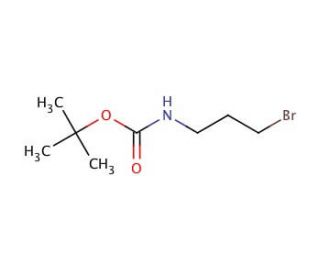

3-(Boc-amino)propyl bromide (CAS 83948-53-2)
QUICK LINKS
3-(Boc-amino)propyl bromide, also referred to as 3-Bromopropylamine-Boc, is an organobromide compound widely utilized as a reagent in organic synthesis. Its primary function is as an alkylating agent, facilitating the introduction of bromine into organic molecules. This colorless liquid exhibits solubility in organic solvents like dichloromethane, dimethyl sulfoxide (DMSO), and dimethylformamide (DMF). The applications of 3-(Boc-amino)propyl bromide span across academic and industrial research. Its uses extend to the synthesis of peptides, peptidomimetics, and oligonucleotides. Furthermore, it finds utility in generating heterocyclic compounds, including pyridines, quinolines, and indoles. The mechanism of action of 3-(Boc-amino)propyl bromide primarily relies on its alkylating properties. It readily reacts with nucleophilic groups, such as amines and thiols, resulting in the formation of covalent bonds. This reaction leads to the production of a bromoalkylated product, which can subsequently undergo further modifications through nucleophilic substitution or hydrolysis.
3-(Boc-amino)propyl bromide (CAS 83948-53-2) References
- Toward biophysical probes for the 5-HT3 receptor: structure-activity relationship study of granisetron derivatives. | Vernekar, SK., et al. 2010. J Med Chem. 53: 2324-8. PMID: 20146481
- Visnagin protects against doxorubicin-induced cardiomyopathy through modulation of mitochondrial malate dehydrogenase. | Liu, Y., et al. 2014. Sci Transl Med. 6: 266ra170. PMID: 25504881
- Multivalent Small-Molecule Pan-RAS Inhibitors. | Welsch, ME., et al. 2017. Cell. 168: 878-889.e29. PMID: 28235199
- Identification of selective 8-(piperidin-4-yloxy)quinoline sulfone and sulfonamide histamine H1 receptor antagonists for use in allergic rhinitis. | Procopiou, PA., et al. 2017. Bioorg Med Chem Lett. 27: 4914-4919. PMID: 28958623
- Polypharmacology-based ceritinib repurposing using integrated functional proteomics. | Kuenzi, BM., et al. 2017. Nat Chem Biol. 13: 1222-1231. PMID: 28991240
- Bimodal Fluorescence-Magnetic Resonance Contrast Agent for Apoptosis Imaging. | Li, H., et al. 2019. J Am Chem Soc. 141: 6224-6233. PMID: 30919628
- Imaging of Fibroblast Activation Protein in Cancer Xenografts Using Novel (4-Quinolinoyl)-glycyl-2-cyanopyrrolidine-Based Small Molecules. | Slania, SL., et al. 2021. J Med Chem. 64: 4059-4070. PMID: 33730493
- Therapeutic Targeting of Protein Disulfide Isomerase PDIA1 in Multiple Myeloma. | Hasipek, M., et al. 2021. Cancers (Basel). 13: PMID: 34071205
- Fluorescence Cross-Correlation Spectroscopy Yields True Affinity and Binding Kinetics of Plasmodium Lactate Transport Inhibitors. | Jakobowska, I., et al. 2021. Pharmaceuticals (Basel). 14: PMID: 34451854
- A Supramolecular Hydrogel Based on Copolymers of Acrylic Acid and Maleic Anhydride Derivatives with Terpyridine Motifs. | Chi, Z., et al. 2022. Polymers (Basel). 14: PMID: 35890633
- Brain Gene Silencing with Cationic Amino-Capped Poly(ethylene glycol) Polyplexes. | Alamoudi, AA., et al. 2022. Biomedicines. 10: PMID: 36140283
Ordering Information
| Product Name | Catalog # | UNIT | Price | Qty | FAVORITES | |
3-(Boc-amino)propyl bromide, 500 mg | sc-231352 | 500 mg | $72.00 |