
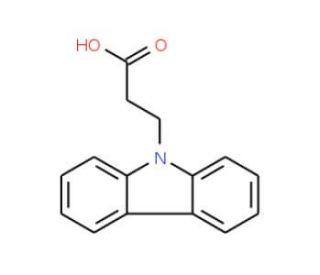

3-(9H-carbazol-9-yl)propanoic acid (CAS 6622-54-4)
QUICK LINKS
3-(9H-Carbazol-9-yl)propanoic acid, a derivative of the carbazole family, is characterized by its unique chemical structure comprising a carbazole ring system attached to a propanoic acid moiety. This compound is of significant interest in research fields due to its intriguing electronic and photophysical properties. The presence of the carbazole nucleus imparts notable photostability and electron-donating capabilities, making it a valuable scaffold in the development of organic semiconductors, optoelectronic materials, and photovoltaic applications. Its mechanism of action is deeply rooted in its ability to facilitate efficient charge transfer and light absorption, characteristics essential for the functioning of OLEDs (Organic Light Emitting Diodes) and OPVs (Organic Photovoltaics). The interaction between the electron-rich carbazole core and the propanoic acid side chain further modulates its solubility and binding affinity, enabling its incorporation into diverse molecular frameworks. Consequently, 3-(9H-Carbazol-9-yl)propanoic acid serves as a cornerstone in the synthesis of novel organic compounds aimed at enhancing the efficiency and durability of electronic and photonic devices, thus playing a pivotal role in the advancement of materials science and nanotechnology research.
3-(9H-carbazol-9-yl)propanoic acid (CAS 6622-54-4) References
- Syntheses, Crystal Structures and Luminescent Properties of Drum and Ladder-Like Organooxotin Clusters with Carbazole Ligand | Jianfang Jiang, Jingwen Liang, Shan Zhao, Yunfeng Wang, Jing Qi, Yong Huang, Ting Xiong & Dongsheng Zhu. 2017. Journal of Cluster Science. 28: 971–982.
- A one-pot, two-step synthesis of 3-deazacanthin-4-ones via sequential Pd-catalyzed Suzuki-Miyaura and Cu-catalyzed Buchwald-Hartwig reactions | Emmanouil Broumidis, Panayiotis A. Koutentis. 2017. Tetrahedron Letters. 58: 2661-2664.
- Viscosity sensitive fluorescent coumarin-carbazole chalcones and their BF2 complexes containing carboxylic acid – Synthesis and solvatochromism | Manali Rajeshirke, Abhinav B. Tathe, Nagaiyan Sekar. 2018. Journal of Molecular Liquids. 264: 358-366.
- Enhancement of NLO Properties in OBO Fluorophores Derived from Carbazole–Coumarin Chalcones Containing Carboxylic Acid at the N-Alykl Terminal End | Manali Rajeshirke, Mavila C. Sreenath, Subramaniyan Chitrambalam, Isaac H. Joe*, and Nagaiyan Sekar*, et al. 2018. J. Phys. Chem. C. 122: 14313–14325.
- Influence of spacer in the formation of nanorings by templateless electropolymerization | F. Sow a, A. Dramé a, S. Sow a, A. Sene a, F. Orange b, S.Y. Dieng a, F. Guittard c d, T. Darmanin. 2020. Materials Today. 17: 100278.
Ordering Information
| Product Name | Catalog # | UNIT | Price | Qty | FAVORITES | |
3-(9H-carbazol-9-yl)propanoic acid, 250 mg | sc-345732 | 250 mg | $197.00 | |||
3-(9H-carbazol-9-yl)propanoic acid, 1 g | sc-345732A | 1 g | $393.00 |