
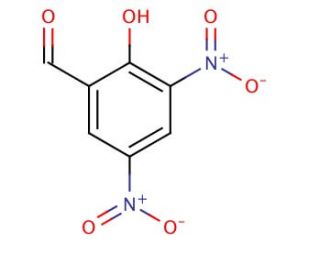

3,5-Dinitrosalicylaldehyde 的分子结构, CAS编号: 2460-59-5
3,5-Dinitrosalicylaldehyde (CAS 2460-59-5)
CAS号码:
2460-59-5
分子量:
212.12
分子式:
(O2N)2C6H2-2-(OH)CHO
仅供科研使用。不可用于诊断或治疗。
* 参考分析证明 大量特定数据 (包括水 含量).
快捷链接
订购信息
描述
技术信息
安全信息
安全技术说明书和分析证明书
3,5-二硝基水杨醛(DNSA)是一种在有机和生物化学实验室中用途广泛且广泛使用的试剂。这种化合物以黄色至橙红色结晶固体存在,在水、醇和各种有机溶剂中具有优异的溶解性。3,5-二硝基水杨醛在科学研究中的广泛应用归因于它与各种分子的广泛反应。它是一种用于蛋白质、碳水化合物和脂质的宝贵标记剂。此外,3,5-二硝基水杨醛可用于检测和定量生物样品中特定分子的浓度,如葡萄糖和胆固醇。此外,这种化合物有助于鉴定生物样品中的某些酶,包括蛋白酶和糖苷酶。3,5-二硝基水杨醛的反应性来自一个称为席夫碱形成的过程。这涉及3,5-二硝基水杨醛分子上的羰基与目标分子上的伯胺基之间的反应。通过该反应,两个分子之间形成共价键,使3,5-二硝基水杨醛能够作为目标分子的可靠标记。
3,5-Dinitrosalicylaldehyde (CAS 2460-59-5) 参考文献
- 使用 3,5-二硝基水杨醛制备一般蛋白酶底物。 | Gallegos, NG., et al. 1996. J Biochem Biophys Methods. 33: 31-41. PMID: 8905466
- 以碘苯为氧化剂催化手性 Ru(II) 西佛碱配合物对苯乙烯衍生物的对映选择性环氧化反应。二 | R.I Kureshy, N.H Khan, S.H.R Abdi, S.T Patel, P Iyer. 1999. Journal of Molecular Catalysis A: Chemical. 150: 175-183.
- 手性钌(II)席夫碱配合物催化的 1,2- 二氢萘对映体选择性环氧化的合成, 物理化学研究和溶剂依赖性。I | R.I Kureshy, N.H Khan, S.H.R Abdi, S.T Patel, P Iyer. 1999. Journal of Molecular Catalysis A: Chemical. 150: 163-173.
- 醛存在时α-氨基酸酯的动态动力学解析 | Daniel A. Schichl, Stephan Enthaler, Wolfgang Holla, Thomas Riermeier, Udo Kragl, Matthias Beller. 2008. European Journal of Organic Chemistry. 2008: 3506-3512.
- 固定在甲基丙烯酸缩水甘油酯三元共聚物上的希夫碱钴(III)配合物在羧酸与末端环氧化物加成反应中的催化活性 | Agnieszka Bukowska, Wiktor Bukowski, Jarosław Noworól. 2010. 117: 655-663.
- 基于荧光黄腙的超分子结构, 分子识别, 顺序逻辑运算和细胞成像 | Kamini Tripathi a, Abhishek Rai a, Amarish Kumar Yadav b, Saripella Srikrishna b, Niraj Kumari *a and Lallan Mishra *a. 2017. RSC Adv. 7: 2264-2272.
订购信息
| 产品名称 | 产品编号 | 规格 | 价格 | 数量 | 收藏夹 | |
3,5-Dinitrosalicylaldehyde, 1 g | sc-226318 | 1 g | $57.00 |