
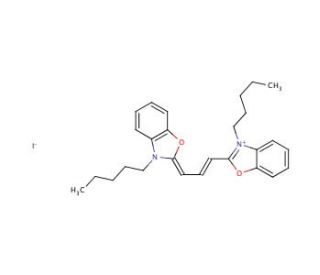

3,3′-Dipentyloxacarbocyanine iodide (CAS 53213-81-3)
QUICK LINKS
3,3′-Dipentyloxacarbocyanine iodide is a synthetic dye that is extensively used in research, particularly within the fields of biophysics and molecular biology. This compound is a cyanine dye, which is characterized by its ability to absorb and emit light in the near-infrared range, making it valuable in fluorescence microscopy and spectroscopy studies. In research applications, 3,3′-Dipentyloxacarbocyanine iodide is utilized to investigate membrane potentials in cells due to its voltage-sensitive properties. The compound is also studied for its incorporation into lipid bilayers, which is instrumental in understanding membrane dynamics and interactions. Research involving 3,3′-Dipentyloxacarbocyanine iodide is critical for the development of non-invasive imaging techniques and for elucidating mechanisms of cellular processes that involve changes in electrical potential across membranes.
3,3′-Dipentyloxacarbocyanine iodide (CAS 53213-81-3) References
- Amphotericin B susceptibility testing of Candida lusitaniae isolates by flow cytofluorometry: comparison with the Etest and the NCCLS broth macrodilution method. | Favel, A., et al. 1999. J Antimicrob Chemother. 43: 227-32. PMID: 11252328
- Voltage- and Ca2+-activated potassium channels in Ca2+ store control Ca2+ release. | Yamashita, M., et al. 2006. FEBS J. 273: 3585-97. PMID: 16884498
- Sensitization to hyperthermia by 3,3'-dipentyloxacarbocyanine iodide: a positive correlation with DNA damage and negative correlations with altered cell morphology, oxygen consumption inhibition, and reduced ATP levels. | Borrelli, MJ., et al. 1991. Int J Hyperthermia. 7: 243-61. PMID: 1880454
- Neutrophil hyperpolarization in response to a chemotactic peptide. | Lazzari, KG., et al. 1990. J Biol Chem. 265: 10959-67. PMID: 2162827
- In vivo selective imaging and inhibition of leukemia stem-like cells using the fluorescent carbocyanine derivative, DiOC5(3). | Zhang, B., et al. 2015. Biomaterials. 52: 14-25. PMID: 25818410
- Role of selenium-dependent glutathione peroxidase in antioxidant defenses in rat alveolar macrophages. | Loeb, GA., et al. 1988. Exp Lung Res. 14 Suppl: 921-36. PMID: 3208729
- The effect of cytosine arabinoside upon mitochondrial staining kinetics in human hematopoietic cells. | Haanen, C., et al. 1986. Histochemistry. 84: 609-13. PMID: 3487533
- Use of lipophilic probes of membrane potential to assess human neutrophil activation. Abnormality in chronic granulomatous disease. | Seligmann, BE. and Gallin, JI. 1980. J Clin Invest. 66: 493-503. PMID: 6249851
- Interrelationships of polymorphonuclear neutrophil membrane-bound calcium, membrane potential, and chemiluminescence: studies in single living cells. | Sullivan, GW., et al. 1984. Blood. 64: 1184-92. PMID: 6437460
- Defective membrane potential changes in neutrophils from human neonates. | Sacchi, F. and Hill, HR. 1984. J Exp Med. 160: 1247-52. PMID: 6481304
- B cell activation. I. Anti-immunoglobulin-induced receptor cross-linking results in a decrease in the plasma membrane potential of murine B lymphocytes. | Monroe, JG. and Cambier, JC. 1983. J Exp Med. 157: 2073-86. PMID: 6602204
- Proton permeability of sarcoplasmic reticulum vesicles. | Meissner, G. and Young, RC. 1980. J Biol Chem. 255: 6814-9. PMID: 7391050
- Adenosine affects the f-met-leu-phe induced changes in cytosolic Ca2+ and in membrane potential of human granulocytes. | Capuozzo, E., et al. 1993. Biochem Mol Biol Int. 30: 1071-9. PMID: 8220253
- Inhibition of mitochondrial and Paracoccus denitrificans NADH-ubiquinone reductase by oxacarbocyanine dyes. A structure-activity study. | Anderson, WM., et al. 1993. Biochem Pharmacol. 45: 2115-22. PMID: 8512593
Ordering Information
| Product Name | Catalog # | UNIT | Price | Qty | FAVORITES | |
3,3′-Dipentyloxacarbocyanine iodide, 100 mg | sc-214164 | 100 mg | $204.00 |