
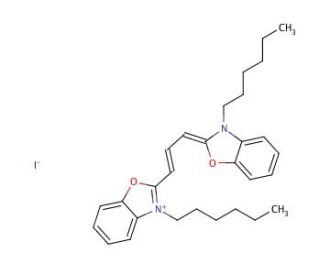

Molecular structure of 3,3′-Dihexyloxacarbocyanine Iodide, CAS Number: 53213-82-4
3,3′-Dihexyloxacarbocyanine Iodide (CAS 53213-82-4)
See product citations (6)
Alternate Names:
DiOC6(3)
CAS Number:
53213-82-4
Purity:
≥95%
Molecular Weight:
572.52
Molecular Formula:
C29H37IN2O2
For Research Use Only. Not Intended for Diagnostic or Therapeutic Use.
* Refer to Certificate of Analysis for lot specific data.
QUICK LINKS
Ordering Information
Product Citations
Description
Technical Information
Safety Information
SDS & Certificate of Analysis
3,3′-Dihexyloxacarbocyanine Iodide is a cationic, voltage-sensitive, cell-permeable, lipophilic, green fluorescent, carbocyanine dye which is utilized as a membrane potential probe. At a low concentration, the dye will selectively stain the mitochondria of live cells. At high concentrations the dye will stain the endoplasmic reticulum and other internal membranes. 3,3′-Dihexyloxacarbocyanine Iodide is a photosensitizer that photodamages microtubules. It is also utilized as an electron transport inhibitor and may be used as a probe to study multi-drug-resistant cells.
3,3′-Dihexyloxacarbocyanine Iodide (CAS 53213-82-4) References
- Cell-to-cell communication via plant endomembranes. | Cantrill, LC., et al. 1999. Cell Biol Int. 23: 653-61. PMID: 10736188
- A G-quadruplex ligand 3,3'-diethyloxadicarbocyanine iodide induces mitochondrion-mediated apoptosis but not decrease of telomerase activity in nasopharyngeal carcinoma NPC-TW01 cells. | Li, CP., et al. 2004. Pharm Res. 21: 93-100. PMID: 14984262
- Methoxyflavone derivatives modulate the effect of TRAIL-induced apoptosis in human leukemic cell lines. | Wudtiwai, B., et al. 2011. J Hematol Oncol. 4: 52. PMID: 22185222
- Protocols for Studying Antimicrobial Peptides (AMPs) as Anticancer Agents. | Madera, L. and Hoskin, DW. 2017. Methods Mol Biol. 1548: 331-343. PMID: 28013516
- In Vitro Apoptosis Induction by Fenofibrate in Lymphoma and Multiple Myeloma. | Schmeel, LC., et al. 2017. Anticancer Res. 37: 3513-3520. PMID: 28668840
- Microfluidic Modeling of Thrombolysis. | Loyau, S., et al. 2018. Arterioscler Thromb Vasc Biol. 38: 2626-2637. PMID: 30354249
- Investigation of cellular effects of thymoquinone on glioma cell. | Guler, EM., et al. 2021. Toxicol Rep. 8: 162-170. PMID: 33489775
- The use of the fluorescent dye, 3,3'-dihexyloxacarbocyanine iodide, for selective staining of ascomycete fungi associated with liverwort rhizoids and ericoid mycorrhizal roots. | Duckett, JG. and Read, DJ. 1991. New Phytol. 118: 259-272. PMID: 33874175
- Nicotinamide improves in vitro lens regeneration in a mouse capsular bag model. | Liu, X., et al. 2022. Stem Cell Res Ther. 13: 198. PMID: 35550648
- Photosensitization by 3,3'-dihexyloxacarbocyanine iodide: specific disruption of microtubules and inactivation of organelle motility. | Lee, C., et al. 1995. Cancer Res. 55: 2063-9. PMID: 7743503
- The fluorescent dye 3, 3' dihexyloxacarbocyanine iodide selectively stains the midpiece and apical region of the heads of murid rodent spermatozoa. | Breed, WG. and Sarafis, V. 1995. Biotech Histochem. 70: 294-6. PMID: 9044657
- Mitochondrial dysfunction in lymphocytes from old mice: enhanced activation of the permeability transition. | Rottenberg, H. and Wu, S. 1997. Biochem Biophys Res Commun. 240: 68-74. PMID: 9367884
- DiOC6(3): a useful dye for staining the endoplasmic reticulum. | Sabnis, RW., et al. 1997. Biotech Histochem. 72: 253-8. PMID: 9408585
Ordering Information
| Product Name | Catalog # | UNIT | Price | Qty | FAVORITES | |
3,3′-Dihexyloxacarbocyanine Iodide, 250 mg | sc-205905 | 250 mg | $87.00 |