
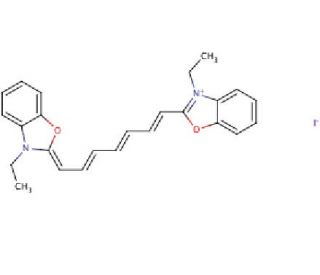

3,3′-Diethyloxatricarbocyanine iodide (CAS 15185-43-0)
QUICK LINKS
3,3′-Diethyloxatricarbocyanine iodide, is a cyanine dye renowned for its application in the measurement of transmembrane potential in a diverse array of cell types. This lipophilic compound is characterized by its ability to incorporate into biological membranes without disrupting their integrity, making it an ideal candidate for non-invasive studies of membrane potential dynamics. The core of its utility lies in its fluorescence properties, which are sensitive to the membrane potential; the dye exhibits a shift in its fluorescence emission spectrum depending on the electric potential across the membrane. This shift enables researchers to quantitatively assess changes in the transmembrane potential, providing insights into cellular processes such as ion transport
3,3′-Diethyloxatricarbocyanine iodide (CAS 15185-43-0) References
- Fluctuation of surface charge in membrane pores. | Bashford, CL., et al. 2002. Biophys J. 82: 2032-40. PMID: 11916860
- Flow cytometric analysis of breast cancer resistance protein expression and function. | Minderman, H., et al. 2002. Cytometry. 48: 59-65. PMID: 12116365
- Regulation of glycolytic oscillations by mitochondrial and plasma membrane H+-ATPases. | Olsen, LF., et al. 2009. Biophys J. 96: 3850-61. PMID: 19413991
- Generation of sub-100-fsec pulses tunable near 497 nm from a colliding-pulse mode-locked ring dye laser. | French, PM. and Taylor, JR. 1988. Opt Lett. 13: 470-2. PMID: 19745935
- A rapid microtiter plate assay for measuring the effect of compounds on Staphylococcus aureus membrane potential. | Gentry, DR., et al. 2010. J Microbiol Methods. 83: 254-6. PMID: 20801170
- Antiproliferative effects of goniothalamin on Ca9-22 oral cancer cells through apoptosis, DNA damage and ROS induction. | Yen, CY., et al. 2012. Mutat Res. 747: 253-8. PMID: 22721813
- Mode of action and structure-activity relationship studies of geobacillin I. | Garg, N., et al. 2014. J Antibiot (Tokyo). 67: 133-6. PMID: 24169799
- Reconfigurable Solid-state Dye-doped Polymer Ring Resonator Lasers. | Chandrahalim, H. and Fan, X. 2015. Sci Rep. 5: 18310. PMID: 26674508
- Fusion of Renewable Ring Resonator Lasers and Ultrafast Laser Inscribed Photonic Waveguides. | Chandrahalim, H., et al. 2016. Sci Rep. 6: 32668. PMID: 27600872
- Transition of colistin dependence into colistin resistance in Acinetobacter baumannii. | Lee, JY., et al. 2017. Sci Rep. 7: 14216. PMID: 29079752
- Phase Fluorometry Using a Continuously Modulated Laser Diode. | Thompson, RB., et al. 1992. Anal Chem. 64: 2075-2078. PMID: 31839680
- Comparative studies on measurement of membrane potential of bacterial cells treated with ZnO nanoparticles by Spectrofluorometry, fluorescence microscopy and flowcytometry. | Khater, M., et al. 2020. J Microbiol Methods. 173: 105920. PMID: 32304720
- Use of a Fluorescence-Based Assay To Measure Escherichia coli Membrane Potential Changes in High Throughput. | Hudson, MA., et al. 2020. Antimicrob Agents Chemother. 64: PMID: 32631824
- Intramitochondrial dyes allow selective in vitro photolysis of carcinoma cells. | Oseroff, AR., et al. 1986. Proc Natl Acad Sci U S A. 83: 9729-33. PMID: 3467335
- DiOC2(3) is not a substrate for multidrug resistance protein (MRP)-mediated drug efflux. | Minderman, H., et al. 1996. Cytometry. 25: 14-20. PMID: 8875050
Ordering Information
| Product Name | Catalog # | UNIT | Price | Qty | FAVORITES | |
3,3′-Diethyloxatricarbocyanine iodide, 200 mg | sc-396646 | 200 mg | $255.00 |