
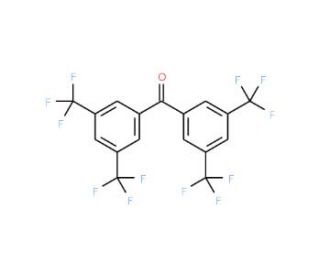

3,3′,5,5′-Tetrakis(trifluoromethyl)benzophenone (CAS 175136-66-0)
Direktverknüpfungen
3,3',5,5'-Tetrakis(trifluormethyl)benzophenon mit der CAS-Nummer 175136-66-0 ist eine multifunktionale organische Verbindung, die sich durch ihre robuste Molekularstruktur auszeichnet, die vier symmetrisch an ein Benzophenon-Grundgerüst gebundene Trifluormethylgruppen enthält. Diese Chemikalie ist in erster Linie für ihre Rolle in verschiedenen Forschungsbereichen bemerkenswert, insbesondere bei der Synthese fortschrittlicher Materialien und bei der Untersuchung chemischer Wechselwirkungen, an denen Pi-Elektronensysteme beteiligt sind. Das Vorhandensein der Trifluormethylgruppen erhöht die Fähigkeit der Verbindung, Elektronen abzuziehen, erheblich, was wiederum ihre Reaktivität und Stabilität beeinflusst und sie zu einem wertvollen Mittel bei der Herstellung von Polymeren und Beschichtungen macht, die eine erhöhte Beständigkeit gegenüber Umweltfaktoren erfordern. Seine Anwendung in der materialwissenschaftlichen Forschung dreht sich häufig um seine Fähigkeit, als Baustein für die Entwicklung von leistungsstarken organischen Verbindungen zu fungieren. Darüber hinaus wird 3,3',5,5'-Tetrakis(trifluormethyl)benzophenon in der Photochemie eingesetzt, wo seine Fähigkeit, ultraviolettes Licht zu absorbieren, genutzt wird, um die Kinetik und die Mechanismen von photoinduzierten chemischen Reaktionen zu untersuchen. Diese Verbindung dient daher nicht nur als entscheidende Komponente bei der Synthese komplexer Moleküle, sondern bietet auch einen umfassenden Nutzen bei der Erforschung grundlegender chemischer Prozesse und Wechselwirkungen und verbessert unser Verständnis des molekularen Verhaltens unter verschiedenen Bedingungen.
3,3′,5,5′-Tetrakis(trifluoromethyl)benzophenone (CAS 175136-66-0) Literaturhinweise
- Metathesereaktionen eines Mangan-Borylen-Komplexes mit polaren Heteroatom-Kohlenstoff-Doppelbindungen: ein Weg zu bisher unzugänglichen Carbenkomplexen. | Bauer, J., et al. 2013. J Am Chem Soc. 135: 8726-34. PMID: 23692498
- Substitutionseffekt auf die Photoreduktionskinetik von Benzophenon. | Demeter, A., et al. 2013. J Phys Chem A. 117: 10196-210. PMID: 23980872
- Hochmesoporöses metallorganisches Gerüst, das in einem schaltbaren Lösungsmittel aufgebaut ist. | Peng, L., et al. 2014. Nat Commun. 5: 4465. PMID: 25047059
- Li gegen Na: Divergierende Reaktionsmuster zwischen Organolithium- und Organonatriumkomplexen und ligandenkatalysierte Keton/Aldehyd-Methylenierung. | Davison, N., et al. 2023. J Am Chem Soc. 145: 6562-6576. PMID: 36890641
- Organokatalytische Michael-Addition von nicht aktivierten α-verzweigten Nitroalkanen zur Herstellung von optisch aktiven tertiären Nitroverbindungen. | Lorea, B., et al. 2023. Org Lett. 25: 8590-8595. PMID: 38009850
- Synthese, Strukturen, Dynamik und Olefinpolymerisationsverhalten von Metallkomplexen der Gruppe 4 (pyCAr2O) 2M (NR2) 2, die zweizähnige Pyridinalkoxid-Hilfsliganden enthalten. | Kim, Il, et al. 1997. Organometallics. 16.15: 3314-3323.
- Metallunterstützte Aminierung mit Oximderivaten. | Narasaka, Koichi. 2002. Pure and applied chemistry. 74.1: 143-149.
- Decarbonylierung von Arylketonen durch sperrige Cyclopentadienylrhodium-bis(ethylen)-Komplexe. | Daugulis, Olafs and Maurice Brookhart. 2004. Organometallics. 23.3: 527-534.
- Neue C 1-symmetrische Ph2C-verbrückte multisubstituierte Ansa-Zirkonocene für die hoch isospezifische Propylenpolymerisation: Synthetischer Ansatz über aktivierte Fulvene. | Kirillov, Evgeny, et al. 2010. Organometallics. 29.21: 5073-5082.
- Basenfreie aerobe Oxidation von Alkoholen über einem Komplex auf Kupferbasis unter Umgebungsbedingungen. | Mei, Qingqing, et al. 2018. ACS sustainable chemistry & engineering. 6.2: 2362-2369.
Bestellinformation
| Produkt | Katalog # | EINHEIT | Preis | ANZAHL | Favoriten | |
3,3′,5,5′-Tetrakis(trifluoromethyl)benzophenone, 1 g | sc-256574 | 1 g | $54.00 |