
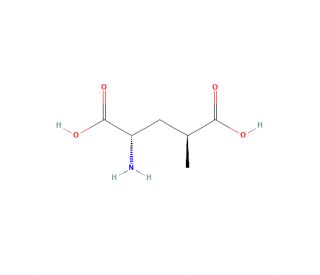

Molecular structure of (2S,4S)-4-Methylglutamic Acid, CAS Number: 6141-27-1
(2S,4S)-4-Methylglutamic Acid (CAS 6141-27-1)
Application:
(2S,4S)-4-Methylglutamic Acid is a highly potent and selective agonist for metabotropic receptors
CAS Number:
6141-27-1
Molecular Weight:
161.16
Molecular Formula:
C6H11NO4
For Research Use Only. Not Intended for Diagnostic or Therapeutic Use.
* Refer to Certificate of Analysis for lot specific data.
QUICK LINKS
Ordering Information
Description
Technical Information
Safety Information
SDS & Certificate of Analysis
(2S,4S)-4-Methylglutamic acid, a non-proteinogenic amino acid derived from glutamic acid, possesses unique properties that make it highly valuable for scientific research. Its extensive utilization stems from its remarkable characteristics, encompassing various biochemical and physiological impacts. This compound functions as a potent agonist of the metabotropic glutamate receptor 4 (mGluR4).By acting as an agonist of the mGluR4 receptor, (2S,4S)-4-Methylglutamic acid initiates the dissociation of G protein subunits upon receptor activation.
(2S,4S)-4-Methylglutamic Acid (CAS 6141-27-1) References
- Pharmacological characterization of a GluR6 kainate receptor in cultured hippocampal neurons. | Bleakman, D., et al. 1999. Eur J Pharmacol. 378: 331-7. PMID: 10493110
- Characteristics and composition of the vitamin K-dependent gamma-glutamyl carboxylase-binding domain on osteocalcin. | Houben, RJ., et al. 2002. Biochem J. 364: 323-8. PMID: 11988107
- A Versatile Boc Solid Phase Synthesis of Daptomycin and Analogues Using Site Specific, On-Resin Ozonolysis to Install the Kynurenine Residue. | Xu, B., et al. 2019. Chemistry. 25: 14101-14107. PMID: 31429133
- An enzymatic synthesis of 4-methyl-L-glutamic acid diastereoisomers. | Righini-Tapie, A. and Azerad, R. 1984. J Appl Biochem. 6: 361-6. PMID: 6536647
- Cytotoxic effects of kainate ligands on HEK cell lines expressing recombinant kainate receptors. | Carver, JM., et al. 1996. Brain Res. 720: 69-74. PMID: 8782898
- Conformational analysis of glutamic acid analogues as probes of glutamate receptors using molecular modelling and NMR methods. Comparison with specific agonists. | Todeschi, N., et al. 1997. Bioorg Med Chem. 5: 335-52. PMID: 9061198
- Inhibition of [3H] gamma-aminobutyric acid release by kainate receptor activation in rat hippocampal synaptosomes. | Cunha, RA., et al. 1997. Eur J Pharmacol. 323: 167-72. PMID: 9128835
- Molecular pharmacology of 4-substituted glutamic acid analogues at ionotropic and metabotropic excitatory amino acid receptors. | Bráuner-Osborne, H., et al. 1997. Eur J Pharmacol. 335: R1-3. PMID: 9369383
- LY339434, a GluR5 kainate receptor agonist. | Small, B., et al. 1998. Neuropharmacology. 37: 1261-7. PMID: 9849663
- Stereospecific synthesis of 4-alkylglutamates and 4-alkylprolines | Claire M. Moody, Douglas W. Young ∗. 1994. Tetrahedron Letters. 35: 7277-7280.
- Diastereoselective synthesis of (2S,4R)-4-Methylglutamic acid (sym 2081): A high affinity and selective ligand at the kainate subtype of glutamate receptors | Zi-Qiang Gu ∗, Xiao-Fa Lin, David P. Hesson. 1995. Bioorganic & Medicinal Chemistry Letters. 5: 1973-1976.
- Stereospecific synthesis of naturally-occurring 4-alkylideneglutamic acids, 4-alkylglutamates and 4-alkylprolines1 | Claire M. Moody and Douglas W. Young. 1997. J. Chem. Soc., Perkin Trans. 1: 3519-3530.
- Chemo-enzymatic synthesis of the four stereoisomers of 4-hydroxy-4-methylglutamic acid | Virgil Helaine, Jean Bolte. 1998. Tetrahedron: Asymmetry. 9: 3855-3861.
- A concise synthesis of (2S,4R)- and (2S,4S)-4-methylglutamic acid | Zi-Qiang Gu a, Min Li b. 2003. Tetrahedron Letters. 44: 3203-3205.
Ordering Information
| Product Name | Catalog # | UNIT | Price | Qty | FAVORITES | |
(2S,4S)-4-Methylglutamic Acid, 5 mg | sc-209430 | 5 mg | $344.00 |