
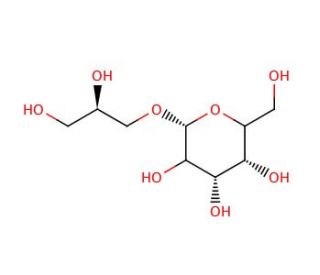

(2R)-Glycerol-O-β-D-galactopyranoside (CAS 16232-91-0)
QUICK LINKS
(2R)-Glycerol-O-beta-D-galactopyranoside (RGG) is a synthetic analog of lactose that plays a role in molecular biology research, especially in studies involving the lac operon system in Escherichia coli (E. coli). This compound is uniquely structured to be an effective substrate for beta-galactosidase, an enzyme that catalyzes the hydrolysis of lactose into glucose and galactose, thus serving as a pivotal tool in examining the functionality and regulation of this enzyme. Moreover, RGG′s compatibility with the lactose transport system enhances its utility in probing the mechanisms underlying lactose uptake and processing within bacterial cells. Its role extends to interactions with the lac repressor, a protein that regulates the expression of the lac operon by binding to the operator region in the absence of lactose, thereby preventing gene transcription. RGG′s ability to interact with this system allows researchers to investigate the dynamics of gene regulation, inducer specificity, and the allosteric effects that govern the switch between the repressed and active states of the lac operon. Additionally, RGG acts as a substrate for thiogalactoside transacetylase, the third enzyme encoded by the lac operon, providing insights into the less understood aspects of this enzyme′s role and its biological significance.
(2R)-Glycerol-O-β-D-galactopyranoside (CAS 16232-91-0) References
- Inhibitory effects of monoacylated 2-O-beta-galactosylglycerols on Epstein-Barr virus activation: the significant role of the hexanoyl chain. | Colombo, D., et al. 1999. Cancer Lett. 143: 1-4. PMID: 10465330
- Glycoglycerolipid analogues active as anti-tumor-promoters: the influence of the anomeric configuration. | Colombo, D., et al. 2000. Eur J Med Chem. 35: 1109-13. PMID: 11248409
- Galactonojirimycin derivatives restore mutant human beta-galactosidase activities expressed in fibroblasts from enzyme-deficient knockout mouse. | Tominaga, L., et al. 2001. Brain Dev. 23: 284-7. PMID: 11504597
- Molecular toolbox for studying diatom biology in Phaeodactylum tricornutum. | Siaut, M., et al. 2007. Gene. 406: 23-35. PMID: 17658702
- Synthesis and characterisation of galactosyl glycerol by β-galactosidase catalysed reverse hydrolysis of galactose and glycerol. | Wei, W., et al. 2013. Food Chem. 141: 3085-92. PMID: 23871063
- Mice kidney biometabolic process analysis after cantharidin exposure using widely-targeted metabolomics combined with network pharmacology. | He, T., et al. 2023. Food Chem Toxicol. 171: 113541. PMID: 36464109
- Calorimetric studies on the mutarotation of D-galactose and D-mannose. | Takahashi, K. and Ono, S. 1973. J Biochem. 73: 763-70. PMID: 4720061
- Synthesis of (2R)-glycerol-o-beta-D-galactopyranoside by beta-galactosidase. | Boos, W. 1982. Methods Enzymol. 89 Pt D: 59-64. PMID: 6815425
Ordering Information
| Product Name | Catalog # | UNIT | Price | Qty | FAVORITES | |
(2R)-Glycerol-O-β-D-galactopyranoside, 10 mg | sc-220842 | 10 mg | $339.00 |