
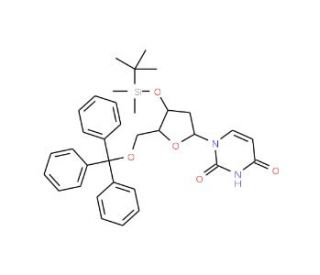

2′-O-(tert-Butyldimethylsilyl)-3′-deoxy-5′-O-trityluridine (CAS 130860-12-7)
ACCÈS RAPIDE AUX LIENS
La 2'-O-(tert-Butyldiméthylsilyl)-3'-déoxy-5'-O-trityluridine est un analogue nucléosidique spécialisé très utilisé dans le domaine de la chimie organique de synthèse, en particulier dans la synthèse des acides nucléiques. Ce composé est une uridine modifiée dans laquelle des groupes hydroxyle spécifiques sont protégés et la position 3' est dépourvue de groupe hydroxyle (ce qui en fait un 3'-déoxy), ce qui affecte considérablement son incorporation dans les chaînes d'acide nucléique et son interaction avec les enzymes. Le groupe 2'-O-(tert-butyldiméthylsilyl) (TBDMS) de cette molécule est un groupe protecteur éther silylique qui empêche l'hydroxyle 2' de participer à des réactions secondaires indésirables au cours de la synthèse chimique. Ce groupe silyle est stable dans diverses conditions mais peut être enlevé sélectivement en présence d'ions fluorure, ce qui permet une fonctionnalisation supplémentaire à cette position une fois que les autres étapes de la synthèse sont terminées. La modification 3'-déoxy est cruciale car elle bloque la formation de la liaison phosphodiester standard 3'-5' que l'on trouve dans l'ARN et l'ADN naturels. Cette modification est utilisée pour étudier le mécanisme des polymérases des acides nucléiques et pour créer des analogues d'acides nucléiques qui peuvent inhiber ces enzymes ou perturber leur fonction normale, ce qui permet de mieux comprendre les processus de réplication et de transcription. Le groupe 5'-O-trityl est un autre groupe protecteur qui assure la stabilité du nucléoside et empêche la polymérisation ou la dégradation. Il peut être enlevé dans des conditions légèrement acides, ce qui permet d'utiliser la position 5' pour la formation de nucléotides et d'oligonucléotides. Cette déprotection sélective est essentielle pour la synthèse par étapes, en particulier dans la synthèse automatisée et manuelle des oligonucléotides.
2′-O-(tert-Butyldimethylsilyl)-3′-deoxy-5′-O-trityluridine (CAS 130860-12-7) Références
- Synthèse et activité anticancéreuse de divers analogues de nucléosides 3'-déoxy pyrimidine et structure cristalline de la 1-(3-déoxy-bêta-D-thréo-pentofuranosyl)cytosine. | Lin, TS., et al. 1991. J Med Chem. 34: 693-701. PMID: 1995894
Informations pour la commande
| Nom du produit | Ref. Catalogue | COND. | Prix HT | QTÉ | Favoris | |
2'-O-(tert-Butyldimethylsilyl)-3'-deoxy-5'-O-trityluridine, 50 mg | sc-209379 | 50 mg | $360.00 |