
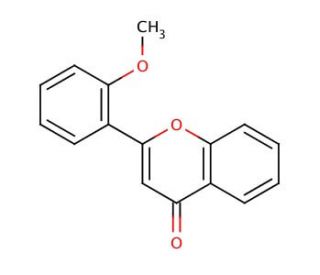

2′-Methoxyflavone (CAS 19725-47-4)
QUICK LINKS
2′-Methoxyflavone is a compound of interest within the area of biochemical research due to its influence on various signaling pathways. It has been the subject of studies investigating its role as a modulator of enzymes such as cytochromes P450, which are for metabolizing a wide array of substances. Additionally, this compound features in research related to its interaction with cellular receptors, notably within the context of elucidating the mechanisms of intracellular communication and gene expression. Its utility extends to agricultural research, where it may impact plant growth and resilience by participating in the regulation of phytohormones. In environmental science, 2′-Methoxyflavone is used as a model substance to understand the fate and transport of similar organic molecules in ecosystems.
2′-Methoxyflavone (CAS 19725-47-4) References
- Inhibition of overexpressed CDC-25.1 phosphatase activity by flavone in Caenorhabditis elegans. | Kim, KS., et al. 2009. Mol Cells. 27: 345-50. PMID: 19326082
- Redox reactivity in propolis: direct detection of free radicals in basic medium and interaction with hemoglobin. | Mot, AC., et al. 2009. Redox Rep. 14: 267-74. PMID: 20003712
- Methoxyflavone derivatives modulate the effect of TRAIL-induced apoptosis in human leukemic cell lines. | Wudtiwai, B., et al. 2011. J Hematol Oncol. 4: 52. PMID: 22185222
- Binding of diverse environmental chemicals with human cytochromes P450 2A13, 2A6, and 1B1 and enzyme inhibition. | Shimada, T., et al. 2013. Chem Res Toxicol. 26: 517-28. PMID: 23432429
- Stereospecific (5) JHortho,OMe couplings in methoxyindoles, methoxycoumarins, and methoxyflavones. | Alvarez-Cisneros, C., et al. 2014. Magn Reson Chem. 52: 491-9. PMID: 25042582
- Structure-activity relationships and molecular docking of thirteen synthesized flavonoids as horseradish peroxidase inhibitors. | Mahfoudi, R., et al. 2017. Bioorg Chem. 74: 201-211. PMID: 28843840
- Molecular docking and two-dimensional quantitative structure-activity relationship studies of synthetic flavonoids on horseradish peroxidase compounds (I, II, and III). | Mahfoudi, R., et al. 2018. J Biochem Mol Toxicol. 32: e22222. PMID: 30230144
- Effect-directed analysis by high-performance thin-layer chromatography for bioactive metabolites tracking in Primula veris flower and Primula boveana leaf extracts. | Mahran, E., et al. 2019. J Chromatogr A. 1605: 460371. PMID: 31375330
- Biotransformation of Methoxyflavones by Selected Entomopathogenic Filamentous Fungi. | Łużny, M., et al. 2020. Int J Mol Sci. 21: PMID: 32854359
- The subgroup of 2'-hydroxy-flavonoids: Molecular diversity, mechanism of action, and anticancer properties. | Bailly, C. 2021. Bioorg Med Chem. 32: 116001. PMID: 33444847
- Antimutagenic effects of flavoniods, chalcones and structurally related compounds on the activity of 2-amino-3-methylinidazo [4, 5-ƒ] quinoline (IQ) and other heterocyclic amine mutagens from cooked food | Edenharder, R. V., Von Petersdorff, I., & Rauscher, R. 1993. Mutation Research/Fundamental and Molecular Mechanisms of Mutagenesis. 287(2): 261-274.
- Methoxyflavone Inhibitors of Cytochrome P450 | McKendall, M., Smith, T., Anh, K., Ellis, J., McGee, T., Foroozesh, M.,.. & Stevens, C. L. K. 2008. Journal of Chemical Crystallography. 38: 231-237.
- Method development and validation for isoflavones quantification in coffee | Alves, R. C., Almeida, I. M. C., Casal, S., & Oliveira, M. B. P. P. 2010. Food chemistry. 122(3): 914-919.
Ordering Information
| Product Name | Catalog # | UNIT | Price | Qty | FAVORITES | |
2′-Methoxyflavone, 1 g | sc-225820 | 1 g | $100.00 |