
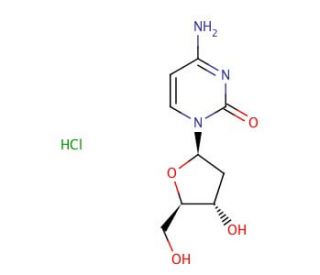

2′-Deoxycytidine hydrochloride (CAS 3992-42-5)
QUICK LINKS
2′-Deoxycytidine hydrochloride (2′-dCyd-HCl) is a synthetic pyrimidine nucleoside analog that is widely used in laboratory experiments to investigate the impact of nucleoside analogs on various cellular processes, including DNA replication and transcription. Structurally resembling natural cytidine, 2′-Deoxycytidine hydrochloride differs only in the presence of a hydroxyl group at the 2′ position of the sugar moiety. Its ability to imitate the effects of natural cytidine and its relatively low cytotoxicity have contributed to its extensive use in scientific research. Researchers have employed 2′-Deoxycytidine hydrochloride in diverse studies, exploring its effects on DNA replication, transcription, and examining its biochemical implications. It has also been utilized in investigations to understand the mechanism of action of nucleoside analogs and assess the advantages and limitations associated with its use in laboratory experiments. The primary mode of action of 2′-Deoxycytidine hydrochloride involves inhibiting DNA replication and transcription. By competing with cytidine, it hampers its incorporation into DNA, thereby impeding proper genetic material replication. Furthermore, 2′-Deoxycytidine hydrochloride can hinder the activity of enzymes vital to DNA replication and transcription, including DNA polymerases and RNA polymerases.
2′-Deoxycytidine hydrochloride (CAS 3992-42-5) References
- Free radical formation in X-irradiated crystals of 2'-deoxycytidine hydrochloride. Electron magnetic resonance studies at 10 K. | Hole, EO., et al. 2000. Radiat Res. 153: 823-34. PMID: 10825758
- 2'-Deoxycytidine hydrochloride protection of mice against the lethal toxicity of cytosine arabinoside. Absence of protection of bone marrow lymphocytes. | Buchman, VM., et al. 1979. Cancer Chemother Pharmacol. 3: 229-34. PMID: 535131
Ordering Information
| Product Name | Catalog # | UNIT | Price | Qty | FAVORITES | |
2′-Deoxycytidine hydrochloride, 1 g | sc-220820 | 1 g | $91.00 |