
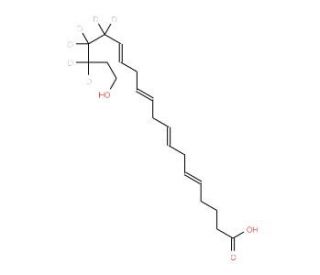

20-HETE-d6
QUICK LINKS
20-HETE-d6 is a deuterated form of 20-hydroxyeicosatetraenoic acid (20-HETE). It contains six deuterium atoms at positions 16, 16′, 17, 17′, 18, and 18′. This isotopic labeling is specifically designed for its use as an internal standard in the quantification of 20-HETE by gas chromatography-mass spectrometry (GC-MS) or liquid chromatography-mass spectrometry (LC-MS). 20-HETE is a metabolite of cytochrome P450 (CYP450) enzymes and is believed to play an autacoid role in the regulation of renal and cerebral vasculature. In rat cerebral microvessels, 20-HETE acts as a vasoconstrictor, contributing to pressure-induced autoregulatory vasoconstriction. The deuterated form, 20-HETE-d6, serves as an analytical tool to accurately measure and quantify endogenous levels of 20-HETE in biological samples. The primary scientific application of 20-HETE-d6 lies in its use as an internal standard in GC-MS or LC-MS methods for the determination of 20-HETE concentrations. By adding a known amount of 20-HETE-d6 to biological samples, researchers can precisely measure the levels of endogenous 20-HETE. This allows for the investigation of 20-HETE′s involvement in various physiological and pathological processes, including vascular regulation, blood pressure control, and cerebral autoregulation. In addition to its vasoconstrictor activity, 20-HETE is known to be excreted mainly as a glucuronide conjugate. Interestingly, the concentration of free 20-HETE in human urine is approximately 10-fold lower than the concentration of its corresponding glucuronide conjugate. This information provides insights into the metabolism and excretion of 20-HETE, which can be further explored using 20-HETE-d6 as an internal standard.
20-HETE-d6 References
- 20-HETE-mediated cytotoxicity and apoptosis in ischemic kidney epithelial cells. | Nilakantan, V., et al. 2008. Am J Physiol Renal Physiol. 294: F562-70. PMID: 18171997
- CYP4F3B is induced by PGA1 in human liver cells: a regulation of the 20-HETE synthesis. | Antoun, J., et al. 2008. J Lipid Res. 49: 2135-41. PMID: 18566475
- 20-HETE mediates proliferation of renal epithelial cells in polycystic kidney disease. | Park, F., et al. 2008. J Am Soc Nephrol. 19: 1929-39. PMID: 18596124
- Intravenous formulation of N-hydroxy-N'-(4-n-butyl-2-methylphenyl)formamidine (HET0016) for inhibition of rat brain 20-hydroxyeicosatetraenoic acid formation. | Mu, Y., et al. 2008. Drug Metab Dispos. 36: 2324-30. PMID: 18725506
- Chronic blockade of 20-HETE synthesis reduces polycystic kidney disease in an orthologous rat model of ARPKD. | Park, F., et al. 2009. Am J Physiol Renal Physiol. 296: F575-82. PMID: 19129252
- Inhibition of 20-HETE synthesis and action protects the kidney from ischemia/reperfusion injury. | Hoff, U., et al. 2011. Kidney Int. 79: 57-65. PMID: 20962739
- Cytochrome P450 ω-hydroxylase promotes angiogenesis and metastasis by upregulation of VEGF and MMP-9 in non-small cell lung cancer. | Yu, W., et al. 2011. Cancer Chemother Pharmacol. 68: 619-29. PMID: 21120482
- Protective effect of 20-HETE inhibition in a model of oxygen-glucose deprivation in hippocampal slice cultures. | Renic, M., et al. 2012. Am J Physiol Heart Circ Physiol. 302: H1285-93. PMID: 22245774
- 20-HETE induces hyperglycemia through the cAMP/PKA-PhK-GP pathway. | Lai, G., et al. 2012. Mol Endocrinol. 26: 1907-16. PMID: 22918876
- 20-HETE is associated with unfavorable outcomes in subarachnoid hemorrhage patients. | Donnelly, MK., et al. 2015. J Cereb Blood Flow Metab. 35: 1515-22. PMID: 25920956
- 20-Hydroxyeicosatetraenoic Acid Is a Key Mediator of Angiotensin II-induced Apoptosis in Cardiac Myocytes. | Zhao, H., et al. 2015. J Cardiovasc Pharmacol. 66: 86-95. PMID: 26164722
- 20-HETE attenuates the response of glucose-stimulated insulin secretion through the AKT/GSK-3β/Glut2 pathway. | Zhang, B., et al. 2016. Endocrine. 54: 371-382. PMID: 27568038
- Upregulation of 20-HETE Synthetic Cytochrome P450 Isoforms by Oxygen-Glucose Deprivation in Cortical Neurons. | Zhang, H., et al. 2017. Cell Mol Neurobiol. 37: 1279-1286. PMID: 28110484
- 20-HETE regulated PSMB5 expression via TGF-β/Smad signaling pathway. | Lai, G., et al. 2018. Prostaglandins Other Lipid Mediat. 134: 123-130. PMID: 28807746
Ordering Information
| Product Name | Catalog # | UNIT | Price | Qty | FAVORITES | |
20-HETE-d6, 25 µg | sc-220839 | 25 µg | $226.00 | |||
20-HETE-d6, 50 µg | sc-220839A | 50 µg | $582.00 |