
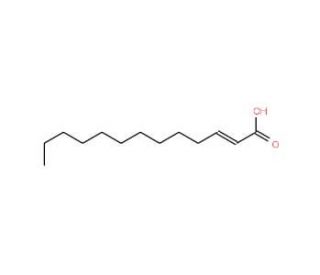

2-Tridecenoic Acid (CAS 6969-16-0)
QUICK LINKS
2-Tridecenoic Acid, a fatty acid derivative, has garnered interest in scientific research due to its potential biological activities and diverse applications. Its mechanism of action often involves interactions with various cellular receptors, enzymes, and signaling pathways, influencing cellular functions and physiological processes. In research, 2-Tridecenoic Acid has been investigated for its antimicrobial properties, particularly against bacterial and fungal pathogens. Studies have shown its inhibitory effects on the growth and proliferation of pathogenic microorganisms, suggesting its potential as a natural antimicrobial agent. Furthermore, this compound has been explored for its role in plant physiology, including its participation in plant defense mechanisms against pests and pathogens. Additionally, research has delved into the synthesis and modification of 2-Tridecenoic Acid derivatives to enhance its biological activities and optimize its efficacy for specific applications. Moreover, its potential as a precursor for the synthesis of various bioactive compounds and as a building block for organic synthesis has also been explored, highlighting its versatility and significance in chemical and biological research.
2-Tridecenoic Acid (CAS 6969-16-0) References
- Infusion of butyrate affects plasma glucose, butyrate, and β-hydroxybutyrate but not plasma insulin in lactating dairy cows. | Herrick, KJ., et al. 2018. J Dairy Sci. 101: 3524-3536. PMID: 29409601
- Chemical Composition, Antioxidant, Anticholinesterase and Anti-Tyrosinase Activities of Essential Oils of Two Sideritis Species from Turkey. | Deveci, E., et al. 2019. Iran J Pharm Res. 18: 903-913. PMID: 31531072
- An Evaluation of Aluminum Tolerant Pseudomonas aeruginosa A7 for In Vivo Suppression of Fusarium Wilt of Chickpea Caused by Fusarium oxysporum f. sp. ciceris and Growth Promotion of Chickpea. | Mozumder, AB., et al. 2022. Microorganisms. 10: PMID: 35336143
- Melanogenesis Inhibitory Activity, Chemical Components and Molecular Docking Studies of Prunus cerasoides Buch.-Ham. D. Don. Flowers. | Kooltheat, N., et al. 2023. J Evid Based Integr Med. 28: 2515690X231152928. PMID: 36740925
- Chemical Studies on the Antibiotic Esperin: Part III. On the Structure of Esperin | Ito, T., & Ogawa, H. 1959. Journal of the Agricultural Chemical Society of Japan. 23(6): 536-547.
- Vinyl proton abstraction during metalation of α-olefins | Broaddus, C. D., Logan, T. J., & Flautt, T. J. 1963. The Journal of Organic Chemistry. 28(5): 1174-1179.
Ordering Information
| Product Name | Catalog # | UNIT | Price | Qty | FAVORITES | |
2-Tridecenoic Acid, 5 g | sc-288320 | 5 g | $165.00 | |||
2-Tridecenoic Acid, 25 g | sc-288320A | 25 g | $482.00 |