
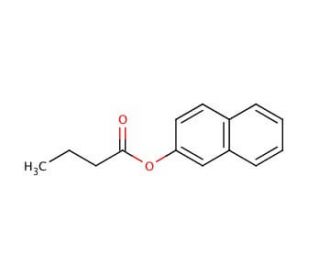

2-Naphthyl butyrate (CAS 5856-33-7)
QUICK LINKS
2-Naphthyl butyrate (2-NB) holds significant importance in the realm of synthetic organic chemistry. This versatile compound presents itself as a colorless to pale yellow liquid. It plays a role as a reagent in diverse analytical methods. 2-Naphthyl serves as a fundamental starting material for the synthesis of compounds like butyric acid esters and amides. Moreover, 2-Naphthyl butyrate proves invaluable as a reagent for the analysis of compounds such as fatty acids and other lipids. In organic chemistry, 2-Naphthyl butyrate functions as a reagent, participating in various organic reactions. In the esterification process, the acid catalyst protonates the alcohol group present in naphthol, rendering it more nucleophilic and enabling its reaction with butyric acid to yield the desired ester. Similarly, in condensation reactions, the acid catalyst protonates the anhydride group of butyric anhydride, enhancing its nucleophilicity and facilitating its reaction with naphthol to form the desired ester.
2-Naphthyl butyrate (CAS 5856-33-7) References
- Microbacterium gubbeenense sp. nov., from the surface of a smear-ripened cheese. | Brennan, NM., et al. 2001. Int J Syst Evol Microbiol. 51: 1969-1976. PMID: 11760936
- Comamonas koreensis sp. nov., a non-motile species from wetland in Woopo, Korea. | Chang, YH., et al. 2002. Int J Syst Evol Microbiol. 52: 377-81. PMID: 11931145
- Microfloral contamination and hydrolytic enzyme differences between monsooned and non-monsooned coffees. | Ahmad, R. and Magan, N. 2002. Lett Appl Microbiol. 34: 279-82. PMID: 11940159
- Reclassification of 'Pseudomonas fluorescens subsp. cellulosa' NCIMB 10462 (Ueda et al. 1952) as Cellvibrio japonicus sp. nov. and revival of Cellvibrio vulgaris sp. nov., nom. rev. and Cellvibrio fulvus sp. nov., nom. rev. | Humphry, DR., et al. 2003. Int J Syst Evol Microbiol. 53: 393-400. PMID: 12710603
- Characterization and distribution of Pasteurella species recovered from infected humans. | Holst, E., et al. 1992. J Clin Microbiol. 30: 2984-7. PMID: 1452670
- Transfer of Chryseobacterium meningosepticum and Chryseobacterium miricola to Elizabethkingia gen. nov. as Elizabethkingia meningoseptica comb. nov. and Elizabethkingia miricola comb. nov. | Kim, KK., et al. 2005. Int J Syst Evol Microbiol. 55: 1287-1293. PMID: 15879269
- Chryseobacterium taiwanense sp. nov., isolated from soil in Taiwan. | Tai, CJ., et al. 2006. Int J Syst Evol Microbiol. 56: 1771-1776. PMID: 16902006
- Isolation of Saccharomyces cerevisiae strains from different food matrices and their preliminary selection for a potential use as probiotics. | Pennacchia, C., et al. 2008. J Appl Microbiol. 105: 1919-28. PMID: 19120638
- Microbiological characteristics of Weeksella virosa (formerly CDC group IIf) isolated from the human genitourinary tract. | Reina, J., et al. 1990. J Clin Microbiol. 28: 2357-9. PMID: 2229364
- Draft genome of Jeotgalibacillus campisalis SF-57(T), a moderate halophilic bacterium isolated from marine saltern. | Yaakop, AS., et al. 2015. Mar Genomics. 23: 59-60. PMID: 25999308
- Limnobacter humi sp. nov., a thiosulfate-oxidizing, heterotrophic bacterium isolated from humus soil, and emended description of the genus Limnobacter Spring et al. 2001. | Nguyen, TM. and Kim, J. 2017. J Microbiol. 55: 508-513. PMID: 28664518
- Epizootics of Pseudomonas anguilliseptica among cultured seabream (Sparus aurata) populations: Control and treatment strategies. | Fadel, A., et al. 2018. Microb Pathog. 121: 1-8. PMID: 29673977
- Isolation and characterization of Enterococcus faecium DSM 20477 with ability to secrete antimicrobial substance for the inhibition of oral pathogen Streptococcus mutans UKMCC 1019. | Ng, ZJ., et al. 2020. Arch Oral Biol. 110: 104617. PMID: 31794906
- Probable new species of Desulfovibrio isolated from a pyogenic liver abscess. | Tee, W., et al. 1996. J Clin Microbiol. 34: 1760-4. PMID: 8784584
Ordering Information
| Product Name | Catalog # | UNIT | Price | Qty | FAVORITES | |
2-Naphthyl butyrate, 250 mg | sc-216255 | 250 mg | $148.00 |