
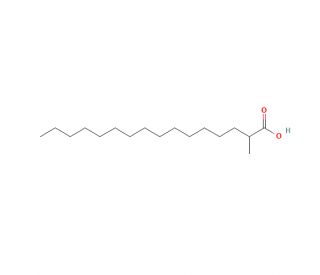

Molecular structure of 2-Methylhexadecanoic Acid
2-Methylhexadecanoic Acid (CAS 27147-71-3)
Alternate Names:
2-Methylpalmitic Acid
CAS Number:
27147-71-3
Molecular Weight:
270.46
Molecular Formula:
C17H34O2
For Research Use Only. Not Intended for Diagnostic or Therapeutic Use.
* Refer to Certificate of Analysis for lot specific data.
QUICK LINKS
Ordering Information
Description
Technical Information
Safety Information
SDS & Certificate of Analysis
2-Methylhexadecanoic acid (2-MHD) is a significant long-chain fatty acid. It plays a vital role as a major component of cell membrane phospholipids and participates in various cellular processes. This fatty acid can also be found in several food sources. The precise mechanism of action of 2-Methylhexadecanoic acid is not yet fully understood. However, it is hypothesized that 2-Methylhexadecanoic acid may act as an agonist for certain receptors, such as the G-protein-coupled receptor GPR40.
2-Methylhexadecanoic Acid (CAS 27147-71-3) References
- Fibroblast studies documenting a case of peroxisomal 2-methylacyl-CoA racemase deficiency: possible link between racemase deficiency and malabsorption and vitamin K deficiency. | Van Veldhoven, PP., et al. 2001. Eur J Clin Invest. 31: 714-22. PMID: 11473573
- Breakdown of 2-hydroxylated straight chain fatty acids via peroxisomal 2-hydroxyphytanoyl-CoA lyase: a revised pathway for the alpha-oxidation of straight chain fatty acids. | Foulon, V., et al. 2005. J Biol Chem. 280: 9802-12. PMID: 15644336
- Promiscuous fatty acyl CoA ligases produce acyl-CoA and acyl-SNAC precursors for polyketide biosynthesis. | Arora, P., et al. 2005. J Am Chem Soc. 127: 9388-9. PMID: 15984864
- Comparison of mechanisms of alkane metabolism under sulfate-reducing conditions among two bacterial isolates and a bacterial consortium. | Callaghan, AV., et al. 2006. Appl Environ Microbiol. 72: 4274-82. PMID: 16751542
- Beta-oxidation in hepatocyte cultures from mice with peroxisomal gene knockouts. | Dirkx, R., et al. 2007. Biochem Biophys Res Commun. 357: 718-23. PMID: 17442273
- Differential activities of peroxisomes along the mouse intestinal epithelium. | Morvay, PL., et al. 2017. Cell Biochem Funct. 35: 144-155. PMID: 28370438
- Phytol-induced pathology in 2-hydroxyacyl-CoA lyase (HACL1) deficient mice. Evidence for a second non-HACL1-related lyase. | Mezzar, S., et al. 2017. Biochim Biophys Acta Mol Cell Biol Lipids. 1862: 972-990. PMID: 28629946
- Microbiological oxidation of long-chain aliphatic compounds. II. Branched-chain alkanes. | Jones, DF. 1968. J Chem Soc Perkin 1. 22: 2809-15. PMID: 5749354
- Mitochondrial beta-oxidation of 2-methyl fatty acids in rat liver. | Mao, LF., et al. 1995. Arch Biochem Biophys. 321: 221-8. PMID: 7639525
- Comparison of fatty acid alpha-oxidation by rat hepatocytes and by liver microsomes fortified with NADPH, Fe3+ and phosphate. | Huang, S., et al. 1994. Lipids. 29: 671-8. PMID: 7861933
- Dilatometric investigation of phase transitions and structures of anhydrous soaps | Skoda, W. 1969. Kolloid-Zeitschrift und Zeitschrift für Polymere. 234: 1128-1138.
- Supercritical fluid chromatographic separation of low-to medium-polarity compounds that are difficult to elute from packed columns | Doehl, J., Farbrot, A., Greibrokk, T., & Iversen, B. 1987. Journal of Chromatography A. 392: 175-184.
- Rapid transesterification and mass spectrometric approach to seed oil analysis | Ayorinde, F. O., Clifton, J., Afolabi, O. A., & Shepard, R. L. 1988. Journal of the American Oil Chemists' Society. 65: 942-947.
Ordering Information
| Product Name | Catalog # | UNIT | Price | Qty | FAVORITES | |
2-Methylhexadecanoic Acid, 1 g | sc-486067 | 1 g | $186.00 |