
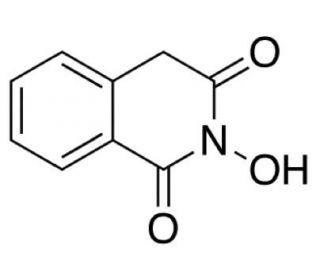

2-Hydroxyisoquinoline-1,3(2H,4H)-dione (CAS 6890-08-0)
QUICK LINKS
2-Hydroxyisoquinoline-1,3(2H,4H)-dione is a chemical compound with a structure based on the isoquinoline scaffold modified by the inclusion of hydroxy and dione functionalities. This structure is particularly notable for its interaction with various biological macromolecules, which makes it an interesting subject for biochemical and molecular research. The primary mechanism of action of 2-Hydroxyisoquinoline-1,3(2H,4H)-dione involves its capacity to bind to metal ions and to interact with nucleic acids and proteins. The hydroxy and dione groups enhance its chelating ability, allowing it to form stable complexes with divalent metal ions such as Mg²⁺, Ca²⁺, and Zn²⁺. This chelating action can affect the availability of essential metal ions in biological systems, which can influence various enzymatic and structural processes. In scientific research, 2-Hydroxyisoquinoline-1,3(2H,4H)-dione is used to study the role of metal ions in enzymatic functions and structural stability of biomolecules. By acting as a metal ion chelator, it helps in understanding how metal depletion or alteration affects the activity of metalloenzymes and the integrity of metal-dependent structural complexes. Additionally, this compound is explored in the study of nucleic acid interactions due to its planar structure, which can intercalate into DNA and RNA strands. Researchers use 2-Hydroxyisoquinoline-1,3(2H,4H)-dione to investigate how intercalation affects the structure, stability, and function of nucleic acids, which is crucial for understanding the mechanisms of gene regulation and the stabilization of nucleic acid structures.
2-Hydroxyisoquinoline-1,3(2H,4H)-dione (CAS 6890-08-0) References
- Magnesium chelating 2-hydroxyisoquinoline-1,3(2H,4H)-diones, as inhibitors of HIV-1 integrase and/or the HIV-1 reverse transcriptase ribonuclease H domain: discovery of a novel selective inhibitor of the ribonuclease H function. | Billamboz, M., et al. 2011. J Med Chem. 54: 1812-24. PMID: 21366258
- Metal and ligand binding to the HIV-RNase H active site are remotely monitored by Ile556. | Zheng, X., et al. 2012. Nucleic Acids Res. 40: 10543-53. PMID: 22941642
- Investigation of a novel series of 2-hydroxyisoquinoline-1,3(2H,4H)-diones as human immunodeficiency virus type 1 integrase inhibitors. | Suchaud, V., et al. 2014. J Med Chem. 57: 4640-60. PMID: 24793360
- Unfolding the HIV-1 reverse transcriptase RNase H domain--how to lose a molecular tug-of-war. | Zheng, X., et al. 2016. Nucleic Acids Res. 44: 1776-88. PMID: 26773054
- 2-hydroxyisoquinoline-1,3(2H,4H)-diones (HIDs) as human immunodeficiency virus type 1 integrase inhibitors: Influence of the alkylcarboxamide substitution of position 4. | Billamboz, M., et al. 2016. Eur J Med Chem. 117: 256-68. PMID: 27105029
- Synthesis, biological evaluation and molecular modeling of 2-Hydroxyisoquinoline-1,3-dione analogues as inhibitors of HIV reverse transcriptase associated ribonuclease H and polymerase. | Tang, J., et al. 2017. Eur J Med Chem. 133: 85-96. PMID: 28384548
- 1-Hydroxypyrido[2,3-d]pyrimidin-2(1H)-ones as novel selective HIV integrase inhibitors obtained via privileged substructure-based compound libraries. | Gao, P., et al. 2017. Bioorg Med Chem. 25: 5779-5789. PMID: 28951095
- Search for new therapeutics against HIV-1 via dual inhibition of RNase H and integrase: current status and future challenges. | Kharkwal, H., et al. 2021. Future Med Chem. 13: 269-286. PMID: 33399497
Ordering Information
| Product Name | Catalog # | UNIT | Price | Qty | FAVORITES | |
2-Hydroxyisoquinoline-1,3(2H,4H)-dione, 100 mg | sc-489621 | 100 mg | $380.00 |