
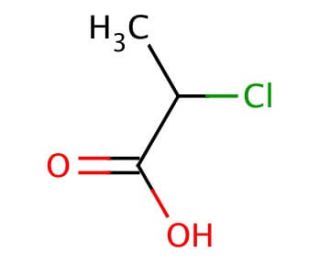

2-Chloropropionic acid 의 분자 구조, CAS 번호: 598-78-7
2-Chloropropionic acid (CAS 598-78-7)
대체 이름:
(±)-2-Chloropropionic acid
CAS 등록번호:
598-78-7
분자량:
108.52
분자식:
C3H5ClO2
추가 정보:
이는 운송용 위험물이며 추가 배송료가 부과될 수 있습니다.
연구용으로만 사용가능합니다. 진단이나 치료용으로 사용불가합니다.
* 참조분석증명서대량의 측정 데이터(함수량포함).
빠른 링크
주문정보
설명
기술정보
안전정보
SDS 및 분석 증명서
염소화 카르복실산인 2-클로로프로피온산은 주로 다른 복잡한 분자를 합성할 때 시약으로 사용되는 역할로 인해 합성 유기 화학 및 연구에서 중추적인 화합물로 자리 잡고 있습니다. 작용 메커니즘은 할로겐산으로서의 반응성에 달려 있으며, 이는 염소 원자를 다른 분자에 기증하여 알킬화제로 작용할 수 있는 핵친화적 치환 반응과 같은 다양한 화학 반응에 참여할 수 있게 해줍니다. 이 특성은 에스테르, 아미드 및 기타 유도체의 합성을 포함하여 보다 복잡한 유기 화합물의 구성에 특히 유용하여 신소재 및 화학물질 개발에 필수적인 도구가 됩니다. 또한 제초제 및 살생물제 생산에 관여하여 농업 연구 및 해충 관리 전략에서 그 중요성이 더욱 강조되고 있습니다. 따라서 2-클로로프로피온산의 다양성과 반응성은 합성 방법론의 발전과 다양한 과학 분야에서 잠재적 응용이 가능한 새로운 화합물의 탐색을 촉진하여 화학 연구에서 두드러지는 데 크게 기여하고 있습니다.
2-Chloropropionic acid (CAS 598-78-7) 참고자료
- 심포지엄 개요: 신경 보호 및 신경 독성에서 글루타치온의 역할. | Monks, TJ., et al. 1999. Toxicol Sci. 51: 161-77. PMID: 10543018
- 독성 물질의 표적으로서의 소뇌. | Fonnum, F. and Lock, EA. 2000. Toxicol Lett. 112-113: 9-16. PMID: 10720707
- 황화나트륨에서 카르펜트라존-에틸의 클로로프로피온산 광환원 [수정됨]. | Ngim, KK. and Crosby, DG. 2002. Environ Toxicol Chem. 21: 2007-13. PMID: 12371474
- 쥐의 뇌에서 2- 클로로 프로피온산의 효과에 대한 마커로서의 푸트레신. | de Vera, N., et al. 2004. Neurosci Lett. 362: 209-12. PMID: 15158016
- VCD 스펙트럼에 대한 강하고 약한 수소 결합 형성의 영향: 2-클로로프로피온산의 사례 연구. | Góbi, S., et al. 2011. Phys Chem Chem Phys. 13: 13972-84. PMID: 21701707
- 근적외선으로 유도된 저온 아르곤 매트릭스에서 2-클로로프로피온산의 형태 변화 및 수소 원자 터널링. | Bazsó, G., et al. 2012. J Phys Chem A. 116: 4823-32. PMID: 22554056
- 포스포프락토키나제 결핍 균주를 사용하여 대장균의 NADPH 생체이용률을 개선합니다. | Wang, Y., et al. 2013. Appl Microbiol Biotechnol. 97: 6883-93. PMID: 23558585
- 2-클로로프로피온산에 대한 Rhizobium sp. RC1의 L-2-할로아산 데할로게나제(DehL)의 항원 특이성에 대한 이론적 분석. | Adamu, A., et al. 2019. J Mol Graph Model. 92: 131-139. PMID: 31352207
- 유지된 나노클러스터 템플릿에서 Au 치환에 의해 유도된 다양한 유형의 리간드 교환. | Du, W., et al. 2020. Inorg Chem. 59: 1675-1681. PMID: 31944677
- 바실러스 세레우스 IndB1의 할로산 데할로게나제와 2-클로로알카노산 기질과의 상호작용에 대한 인실리코 분석. | Ratnaningsih, E. and Saepulloh, S. 2022. ScientificWorldJournal. 2022: 1579194. PMID: 36254337
- 반대 입체 특이성을 가진 할로알카노에이트 탈할로겐화 효소를 코딩하는 두 개의 Rhizobium sp. 유전자의 대장균에서의 복제, 시퀀싱 및 발현. | Cairns, SS., et al. 1996. Eur J Biochem. 235: 744-9. PMID: 8654424
- 2-클로로프로피온산 경구 투여 후 쥐 뇌의 신경 병리학적 변화. | Simpson, MG., et al. 1996. Neurotoxicology. 17: 471-80. PMID: 8856742
- 헤일로알카노에이트 데할로게나제 II(DehE)의 리조비움 sp.-유전자 분자 분석 및 효소에 의한 트리할로아세테이트에서 일산화탄소 형성. | Stringfellow, JM., et al. 1997. Eur J Biochem. 250: 789-93. PMID: 9461303
주문정보
| 제품명 | 카탈로그 번호 | 단위 | 가격 | 수량 | 관심품목 | |
2-Chloropropionic acid, 100 g | sc-256123 | 100 g | $22.00 |