
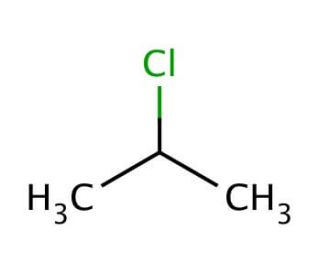

Molecular structure of 2-Chloropropane, CAS Number: 75-29-6
2-Chloropropane (CAS 75-29-6)
Alternate Names:
Isopropyl chloride
CAS Number:
75-29-6
Purity:
≥98%
Molecular Weight:
78.54
Molecular Formula:
C3H7Cl
Supplemental Information:
This is classified as a Dangerous Good for transport and may be subject to additional shipping charges.
For Research Use Only. Not Intended for Diagnostic or Therapeutic Use.
* Refer to Certificate of Analysis for lot specific data.
QUICK LINKS
Ordering Information
Description
Technical Information
Safety Information
SDS & Certificate of Analysis
2-Chloropropane is a colorless, flammable liquid characterized by a strong and unpleasant odor. This versatile organic compound finds widespread use in both industrial and scientific realms. Its applications span the synthesis of various compounds. Due to its broad utility, 2-Chloropropane holds significant importance in the chemical industry and has undergone extensive study to explore its potential applications. In scientific research, it serves as a valuable reagent in organic synthesis and plays a pivotal role as a solvent for various organic compounds. Notably, 2-Chloropropane facilitates the synthesis of other compounds, such as polychloropropanes and polychloropropene.
2-Chloropropane (CAS 75-29-6) References
- Influence of oil composition on the formation of fatty acid esters of 2-chloropropane-1,3-diol (2-MCPD) and 3-chloropropane-1,2-diol (3-MCPD) under conditions simulating oil refining. | Ermacora, A. and Hrncirik, K. 2014. Food Chem. 161: 383-9. PMID: 24837966
- Analytical procedure for the determination of very volatile organic compounds (C3-C6) in indoor air. | Schieweck, A., et al. 2018. Anal Bioanal Chem. 410: 3171-3183. PMID: 29594428
- Design, synthesis and biological evaluation of novel 4-anlinoquinazoline derivatives as EGFR inhibitors with the potential to inhibit the gefitinib-resistant nonsmall cell lung cancers. | Wang, C., et al. 2019. J Enzyme Inhib Med Chem. 34: 203-217. PMID: 30835140
- Disposable cartridge concept for the on-demand synthesis of turbo Grignards, Knochel-Hauser amides, and magnesium alkoxides. | Berton, M., et al. 2020. Beilstein J Org Chem. 16: 1343-1356. PMID: 32595782
- Clinical and pathologic features of acute bovine liver disease in Australia. | Manthorpe, EM., et al. 2021. J Vet Diagn Invest. 33: 875-883. PMID: 34176375
- Pd-catalyzed cross-electrophile Coupling/C-H alkylation reaction enabled by a mediator generated via C(sp3)-H activation. | Wu, Z., et al. 2021. Chem Sci. 12: 8531-8536. PMID: 34221334
- Amino Acid Based Antimicrobial Agents - Synthesis and Properties. | Nowak, MG., et al. 2021. ChemMedChem. 16: 3513-3544. PMID: 34596961
- Base-Mediated Coupling Reactions of Benzenesulfonyl Azides with Proline: Synthesis of Proline-Derived Benzenesulfonamides. | Liu, H., et al. 2021. ACS Omega. 6: 34796-34804. PMID: 34963962
- Yeast Protein as an Easily Accessible Food Source. | Jach, ME., et al. 2022. Metabolites. 12: PMID: 35050185
- Isobutane/2-butene alkylation catalyzed by Brønsted-Lewis acidic ionic liquids. | Liu, S., et al. 2018. RSC Adv. 8: 19551-19559. PMID: 35541003
- Discovery of pyrazolo[3,4-d]pyrimidine and pyrazolo[4,3-e][1,2,4]triazolo[1,5-c]pyrimidine derivatives as novel CDK2 inhibitors: synthesis, biological and molecular modeling investigations. | Nassar, IF., et al. 2022. RSC Adv. 12: 14865-14882. PMID: 35702208
- Analytical Method Development for 19 Alkyl Halides as Potential Genotoxic Impurities by Analytical Quality by Design. | Lee, K., et al. 2022. Molecules. 27: PMID: 35889310
- New Model to Predict Infinite Dilution Activity Coefficients Based on (∂p/∂x) T,x → 0. | Zheng, J., et al. 2023. ACS Omega. 8: 12439-12444. PMID: 37033839
Ordering Information
| Product Name | Catalog # | UNIT | Price | Qty | FAVORITES | |
2-Chloropropane, 100 ml | sc-238010 | 100 ml | $36.00 |