
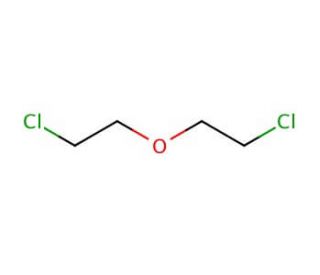

2-Chloroethyl ether (CAS 111-44-4)
Direktverknüpfungen
2-Chlorethylether wird in der Forschung in großem Umfang eingesetzt, insbesondere im Bereich der organischen Synthese, wo er als vielseitiges Alkylierungsmittel wirkt. 2-Chlorethylether dient zur Einführung der 2-Chlorethylgruppe in andere chemische Strukturen und ermöglicht so die Untersuchung von molekularen Wechselwirkungen und Reaktionsmechanismen, die für die Entwicklung neuer Materialien und Chemikalien von Bedeutung sind. 2-Chlorethylether wird wegen seines Potenzials für die Synthese von Ethern und Estern untersucht, die für verschiedene industrielle Anwendungen wie Lösungsmittel und Zwischenprodukte für die Herstellung komplexerer Moleküle wichtig sind. Die Untersuchung der Reaktivität und Stabilität von 2-Chlorethylether unter verschiedenen Bedingungen ist ebenfalls von entscheidender Bedeutung, um eine sichere Handhabung und effektive Anwendung sowohl im Labor als auch in der Industrie zu gewährleisten.
2-Chloroethyl ether (CAS 111-44-4) Literaturhinweise
- Bis(2-Chlorethyl)ether. | . 1999. IARC Monogr Eval Carcinog Risks Hum. 71 Pt 3: 1265-9. PMID: 10476394
- Schwefel-Senf-stimulierte Protease: ein Ziel für antivirale Medikamente. | Ray, P., et al. 2002. J Appl Toxicol. 22: 139-40. PMID: 11920939
- Abbau von 2-Chlorethylvinylether durch Ancylobacter aquaticus AD25 und AD27. | van den Wijngaard, AJ., et al. 1993. Appl Environ Microbiol. 59: 2777-83. PMID: 16349032
- Die Entdeckung der Kronenether. | Pedersen, CJ. 1988. Science. 241: 536-40. PMID: 17774576
- Biologischer Abbau von Bis(2-chlorethyl)ether durch Xanthobacter sp. Stamm ENV481. | McClay, K., et al. 2007. Appl Environ Microbiol. 73: 6870-5. PMID: 17873075
- Oberflächenkatalysierte Fenton-Behandlung von Bis(2-chlorethyl)ether und Bis(2-chlorethoxy)methan. | Mutuc, MD., et al. 2008. Chemosphere. 70: 1390-8. PMID: 18061235
- Mobilität und Sorption von Bis-2-Chlorethylether in einem Aquifer-Material. | Bednar, AJ., et al. 2009. J Hazard Mater. 168: 1041-6. PMID: 19345490
- Chemische Oxidation von Bis(2-chlorethyl)ether im Fenton-Verfahren: Kinetik, Reaktionswege und Bewertung der Toxizität. | Shi, J., et al. 2017. Chemosphere. 180: 117-124. PMID: 28395149
- Bewertung des anaeroben biologischen Abbaus von Bis(2-Chlorethyl)ether im Grundwasser mit Hilfe der Kohlenstoff- und Chlorverbindungs-spezifischen Isotopenanalyse. | Segal, DC., et al. 2018. Sci Total Environ. 625: 696-705. PMID: 29306157
- Mechanistische Untersuchung der atmosphärischen Oxidation von Bis(2-chlorethyl)ether (ClCH2CH2OCH2CH2Cl) durch OH- und NO3-Radikale und Cl-Atome: ein DFT-Ansatz. | Paul, S., et al. 2019. J Mol Model. 25: 43. PMID: 30675641
- Merkmale und Mechanismus der kationischen Polymerisation von Vinylether in wässrigen Medien, initiiert durch Alkohol/B(C₆F₅)₃/Et₂O. | Zhang, J., et al. 2019. Polymers (Basel). 11: PMID: 30960484
- Abbaukinetik und -mechanismus von Bis(2-chlorethyl)ether durch elektromagnetische Induktion elektrodenlose Lampe aktiviertes Persulfat. | Zhou, Y., et al. 2020. Chemosphere. 261: 127709. PMID: 32745742
- Thiodiglykolsäure: ein wichtiger Metabolit von Bis(2-chlorethyl)ether. | Lingg, RD., et al. 1979. Toxicol Appl Pharmacol. 47: 23-34. PMID: 425117
- Stoffwechsel von Bis(2-chlorethyl)ether und Bis(2-chlorisopropyl)ether in der Ratte. | Lingg, RD., et al. 1982. Arch Environ Contam Toxicol. 11: 173-83. PMID: 6807217
Bestellinformation
| Produkt | Katalog # | EINHEIT | Preis | ANZAHL | Favoriten | |
2-Chloroethyl ether, 5 g | sc-238000 | 5 g | $32.00 | |||
2-Chloroethyl ether, 100 g | sc-238000A | 100 g | $45.00 |