
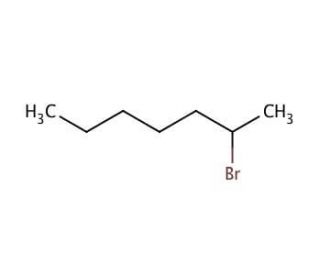

Molecular structure of 2-Bromoheptane, CAS Number: 1974-04-5
2-Bromoheptane (CAS 1974-04-5)
Alternate Names:
1-Methylhexyl bromide
CAS Number:
1974-04-5
Molecular Weight:
179.10
Molecular Formula:
CH3CH2CH2CH2CH2CHBrCH3
Supplemental Information:
This is classified as a Dangerous Good for transport and may be subject to additional shipping charges.
For Research Use Only. Not Intended for Diagnostic or Therapeutic Use.
* Refer to Certificate of Analysis for lot specific data.
QUICK LINKS
Ordering Information
Description
Technical Information
Safety Information
SDS & Certificate of Analysis
2-Bromoheptane is widely used in scientific research as a reagent for the synthesis of various organic compounds. It is employed in the synthesis of agrochemicals, surfactants, detergents, and lubricants. It acts as an alkylating agent, which means that it can transfer its alkyl group to other molecules. This can result in the formation of covalent bonds between 2-Bromoheptane and other molecules, which can alter their chemical and physical properties.
2-Bromoheptane (CAS 1974-04-5) References
- Alkylboronic esters from copper-catalyzed borylation of primary and secondary alkyl halides and pseudohalides. | Yang, CT., et al. 2012. Angew Chem Int Ed Engl. 51: 528-32. PMID: 22135233
- Nickel-catalyzed reductive coupling of aryl halides with secondary alkyl bromides and allylic acetate. | Wang, S., et al. 2012. Org Lett. 14: 3352-5. PMID: 22697415
- Nickel-catalyzed reductive conjugate addition to enones via allylnickel intermediates. | Shrestha, R., et al. 2013. J Am Chem Soc. 135: 751-62. PMID: 23270480
- Dynamics and hydration explain failed functional transformation in dehalogenase design. | Sykora, J., et al. 2014. Nat Chem Biol. 10: 428-30. PMID: 24727901
- Remote carboxylation of halogenated aliphatic hydrocarbons with carbon dioxide. | Juliá-Hernández, F., et al. 2017. Nature. 545: 84-88. PMID: 28470192
- Site-Selective, Remote sp3 C-H Carboxylation Enabled by the Merger of Photoredox and Nickel Catalysis. | Sahoo, B., et al. 2019. Chemistry. 25: 9001-9005. PMID: 31074058
- Synthesis and analgesic evaluation of 4-(2-heptyloxy)-7-[(Z)-(3-hydroxycyclohexyl)]indole: a caveat on indole-phenol bioisosterism. | Soll, RM., et al. 1986. J Med Chem. 29: 1457-60. PMID: 3735313
- Cannabinoids. Structure-activity studies related to 1,2-dimethylheptyl derivatives. | Loev, B., et al. 1973. J Med Chem. 16: 1200-6. PMID: 4795866
- Tetrahydrocannabinol analogs. Synthesis of 2-(3-methyl-2-octyl)-3-hydroxy-6,6,9-trimethyl-7,8,9,10-tetrahydrodibenzo(b,d)pyran. | Taylor, EC., et al. 1967. Tetrahedron. 23: 77-85. PMID: 6037293
- Dehydrobromination of secondary and tertiary alkyl and cycloalkyl bromides with 1,8-diazabicyclo[5.4.0]undec-7-ene. Synthetic applications | Peder Wolkoff, et al. 1982. J. Org. Chem. 47: 1944–1948.
- Reactions of P(MeNCH2CH2)3N with primary, secondary, and tertiary alkyl halides: Evidence for a solvent-enhanced dehydrohalogenation | T. Mohan, S. Arumugam, T. Wang, R. A. Jacobson, J. G. Verkade. 1996. Heteroatom Chemistry. 7: 455-460.
- Highly Efficient Oxidative Bromination of Alkanes with the HBr-H2O2 System in the Presence of Catalyst | Yujin Li, Jie Ju, Jianhong Jia, Weijian Sheng, Liang Han, Jianrong Gao. 2010. Chinese Journal of Chemistry. 28: 2428-2432.
- Supramolecular chiral surface of nickel sulfate hexahydrate crystals and its ability to chirally recognize enantiomers by adsorption data | Vladimir Yu. Gus'kov, *a Darya A. Allayarova, a Gulnaz Z. Garipovaa and Irina N. Pavlovab . 2020. New J. Chem. 4: 17769-17779.
- A Chiral Stationary Phase Based on Guanine Conglomerates Obtained under Viedma Ripening Conditions | N. I. Sairanova & Yu. Yu. Gainullina. 2021. Journal of Analytical Chemistry. 76: 1321–1326.
Ordering Information
| Product Name | Catalog # | UNIT | Price | Qty | FAVORITES | |
2-Bromoheptane, 25 g | sc-225242 | 25 g | $67.00 |