
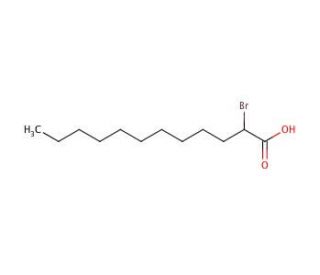

2-Bromododecanoic acid (CAS 111-56-8)
Direktverknüpfungen
2-Bromdodecansäure wirkt als Hemmstoff in bestimmten biochemischen Reaktionen. Sie wirkt durch Bindung an bestimmte Enzyme oder Proteine, wodurch deren normale Funktion gestört und der Ablauf der Reaktion gehemmt wird. Diese Störung erfolgt auf molekularer Ebene, wo die 2-Bromdodecansäure aufgrund ihrer Struktur mit dem aktiven Zentrum des Enzyms oder Proteins interagieren kann, wodurch die Bindung des Substrats verhindert und die katalytische Aktivität gehemmt wird. Der Wirkmechanismus der 2-Bromdodecansäure besteht darin, den normalen Ablauf der Reaktion zu stören, was letztlich zu einer Verringerung der Produktion des gewünschten Produkts führt. Auf diese Weise spielt 2-Bromdodecansäure eine Rolle bei der Modulation der Aktivität bestimmter Enzyme oder Proteine in experimentellen Anwendungen.
2-Bromododecanoic acid (CAS 111-56-8) Literaturhinweise
- Fettsäure-induzierte Cholecystokinin-Sekretion und Veränderungen im intrazellulären Ca2+ in zwei enteroendokrinen Zelllinien, STC-1 und GLUTag. | Sidhu, SS., et al. 2000. J Physiol. 528 Pt 1: 165-76. PMID: 11018115
- La mobilizzazione del calcio e la secrezione di CCK indotte da acidi grassi modificati e microsfere di lattice rivelano meccanismi a doppio recettore per la stimolazione dei lipidi delle cellule STC-1. | Kazmi, S., et al. 2003. J Physiol. 553: 759-73. PMID: 14555726
- Physikalisch-chemische Eigenschaften von anionischen dreifachkettigen Tensiden in alkalischen Lösungen. | Yoshimura, T. and Esumi, K. 2004. J Colloid Interface Sci. 276: 450-5. PMID: 15271573
- Synthese von amphiphilen Derivaten von Rosenbengalen und ihre Akkumulation in Tumoren. | Sugita, N., et al. 2007. Bioconjug Chem. 18: 866-73. PMID: 17367181
- Verbesserung der oralen Absorption des Dipeptids L-Glu-L-Trp-OH durch Lipid- und Glykosylkonjugation. | Bergeon, JA., et al. 2008. Biopolymers. 90: 633-43. PMID: 18428206
- Esterbildung durch symbiotische Aktivierung unter Verwendung von Trichloracetimidat-Elektrophilen. | Mahajani, NS., et al. 2019. J Org Chem. 84: 7871-7882. PMID: 31117564
- N-(2-Naphthyl)-23,24-dinor-5-cholen-22-amin-3beta-ol, ein fluoreszierendes Cholesterin-Analogon. | Kao, YJ., et al. 1978. Biochemistry. 17: 2689-96. PMID: 678537
- Chirale Unterscheidung durch Albumin: eine mechanistische Studie zur flüssigchromatographischen optischen Auflösung von nichtaromatischen Carbonsäuren. | Allenmark, S. 1993. Chirality. 5: 295-9. PMID: 8398590
- Beteiligung von Carnitin-Acyltransferasen am peroxisomalen Fettsäurestoffwechsel in der Hefe Pichia guilliermondii. | Pagot, Y. and Belin, JM. 1996. Appl Environ Microbiol. 62: 3864-7. PMID: 8837442
- Bewertung der selektiven Wechselwirkung von Ga3+ mit N-Octadecanoyl-N-phenylhydroxylamin mittels L-B-Technik. | Okushita, H. and Shimidzu, T. 1996. J Colloid Interface Sci. 183: 315-9. PMID: 8954669
- Fettsäuren stimulieren die Cholecystokinin-Sekretion über einen Acylkettenlängen-spezifischen, Ca2+-abhängigen Mechanismus in der enteroendokrinen Zelllinie STC-1. | McLaughlin, JT., et al. 1998. J Physiol. 513 (Pt 1): 11-8. PMID: 9782155
Bestellinformation
| Produkt | Katalog # | EINHEIT | Preis | ANZAHL | Favoriten | |
2-Bromododecanoic acid, 5 g | sc-223434 | 5 g | $56.00 |