
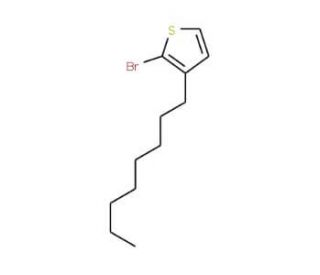

2-Bromo-3-octylthiophene (CAS 145543-83-5)
QUICK LINKS
2-Bromo-3-octylthiophene, often abbreviated as 2-Br-3-OT, is an aromatic compound hinged on a thiophene base with an attached branched alkyl side chain. This colorless liquid exhibits solubility in a majority of organic solvents and is characterized by low volatility. It acts as a critical component in the synthesis of a wide range of organic molecules and serves as a reagent in polymer synthesis. Furthermore, it is utilized as a foundational building block in nanomaterial production. Beyond these uses, 2-Bromo-3-octylthiophene has demonstrated potential biological activity in varying environments. Its utility extends to the synthesis of diverse organic molecules, including dyes, and it plays a vital role in the development of polymers and nanomaterials. The compound has demonstrated cytotoxic effects on various cell lines, including human breast and colon cancer cells. Studies also suggest that 2-Bromo-3-octylthiophene may inhibit the growth of certain bacterial strains like Staphylococcus aureus and Escherichia coli. However, the precise mechanism of action of 2-Bromo-3-octylthiophene remains an area of ongoing study. Preliminary research indicates that it may function as an inhibitor of specific enzymes, including topoisomerase I and DNA gyrase, and potentially restrict the activity of certain transcription factors, such as NF-κB.
2-Bromo-3-octylthiophene (CAS 145543-83-5) References
- Influence of Block Ratio on Thermal, Optical, and Photovoltaic Properties of Poly(3-hexylthiophene)-b-poly(3-butylthiophene)-b-poly(3-octylthiophene). | Nguyen, VH., et al. 2022. Molecules. 27: PMID: 36500557
- Electrochemical preparation and characterization of a new conducting copolymer of 2,7-carbazole and 3-octylthiophene | , et al. (2017). Polymer Bulletin. volume 74,: pages 1649–1660.
- UV–VIS–NIR and Raman spectroelectrochemistry of regioregular poly(3-octylthiophene): comparison with its non-regioregular analogue | Miroslaw Trznadel, Malgorzata Zagórska, Mieczyslaw Lapkowski, Guy Louarn, Serge Lefrant and Adam Pron., 1996. Journal of the Chemical Society, Faraday Transactions. Issue 8: 1387-1393.
- Efficient synthesis of benzobisazole terpolymers containing thiophene and fluorene† | Jared F. Mike a, Jeremy J. Intemann a, Min Cai b, Teng Xiao b, Ruth Shinar c, Joseph Shinar b and Malika Jeffries-EL *a. 2011. Polym. Chem.,., 2,: 2299-2305.
- Palladium-catalyzed synthesis of oligo(alkylthiophenes) | . 18 March 2003,. Journal of Molecular Catalysis A: Chemical Volume 195, Issues 1–2,: Pages 125-131.
Ordering Information
| Product Name | Catalog # | UNIT | Price | Qty | FAVORITES | |
2-Bromo-3-octylthiophene, 5 g | sc-225196 | 5 g | $134.00 |