
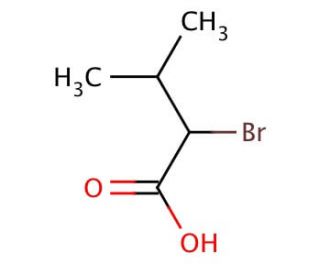

2-Bromo-3-methylbutyric acid 의 분자 구조, CAS 번호: 565-74-2
2-Bromo-3-methylbutyric acid (CAS 565-74-2)
대체 이름:
α-Bromoisovaleric acid; 2-Bromoisovaleric acid
CAS 등록번호:
565-74-2
분자량:
181.03
분자식:
C5H9BrO2
추가 정보:
운송용 위험물로 분류되어 추가 배송료가 부과될 수 있습니다.
연구용으로만 사용가능합니다. 진단이나 치료용으로 사용불가합니다.
* Refer to Certificate of Analysis for lot specific data.
빠른 링크
주문정보
설명
기술정보
안전정보
SDS 및 분석 증명서
2-BMB로 알려진 2-브로모-3-메틸부티르산은 다양한 과학 연구 및 실험실 실험에서 광범위하게 사용되는 중요한 유기 화합물이다. 이 브롬화 카르복실산은 유기산 계열에 속하며 다양한 화학 반응, 특히 친핵체 및 친전자체와 관련된 화학 반응에 유용하게 사용된다. 또한 특정 반응에서 촉매 역할을 한다. 그 구조는 메틸기에 브롬 원자가 2개의 카르복실산 그룹과 결합하여 있다. 2-브로모-3-메틸부티르산은 과학 연구 분야에서 탁월한 유용성을 보여준다. 그 용도는 폴리우레탄, 폴리에틸렌 및 폴리프로필렌과 같은 폴리머에 사용된다. 또한 생화학 및 분자 생물학 연구에 사용되는 다양한 화합물의 합성에 기여한다. 2-브로모-3-메틸부티르산은 유기산으로서 다른 분자와 수소 결합을 형성하는 능력을 가지고 있다. 이러한 수소 결합은 친핵체 및 친전자체와의 복합체 형성을 촉진하며, 이들은 다른 분자와 화학 결합을 형성하는 능력을 가지고 있다. 따라서 2-브로모-3-메틸부티르산은 특정 화학 반응에서 촉매 역할을 한다.
2-Bromo-3-methylbutyric acid (CAS 565-74-2) 참고자료
- 거대 고리형 항생제를 이용한 키랄 분리: 검토. | Ward, TJ. and Farris, AB. 2001. J Chromatogr A. 906: 73-89. PMID: 11215904
- 식품 분석에서의 키랄 전기 이동 방법. | Simó, C., et al. 2003. Electrophoresis. 24: 2431-41. PMID: 12900853
- 키랄 카르복실산의 엔안티오스 선택적 감지. | Mei, X. and Wolf, C. 2004. J Am Chem Soc. 126: 14736-7. PMID: 15535695
- 동시 캡슐화: 분자를 가까운 거리에 유지. | Rebek, J. 2005. Angew Chem Int Ed Engl. 44: 2068-78. PMID: 15761888
- 거대 고리형 항생제 리스토세틴 A의 희석 용액으로 고도로 선택적인 모세관 전기영동 분리를 수행합니다. | Armstrong, DW., et al. 1995. J Chromatogr A. 689: 285-304. PMID: 7874302
- 공유 결합된 거대 고리형 항생제인 리스토세틴 A, 키랄 고정상을 사용하여 고도로 엔안티오선택적인 HPLC 분리를 수행합니다. | Ekborg-Ott, KH., et al. 1998. Chirality. 10: 434-83. PMID: 9691460
- 2- 아닐리노-3-메틸부티레이트 및 2-(이소인돌린-2-일)-3-메틸부티레이트, 사이클로프로판 고리를 포함하지 않는 새로운 합성 피레스로이드 에스테르의 두 그룹 | Clive A. Henrick, Barbara A. Garcia, Gerardus B. Staal, David C. Cerf, Richard J. Anderson, Karen Gill, Henry R. Chinn, Jeffrey N. Labovitz, Michael M. Leippe, Sam L. Woo, Robert L. Carney, Douglas C. Gordon, Gustave K. Kohn. 1980. Pesticide Science. 11: 224-241.
- 인산염 매개 현장 카복시 비닐화: 새로운 일반 아크릴산 합성 | David R. Brittelli. 1981. J. Org. Chem. 46: 2514–2520.
- 기체상에서 2-브로모-3-메틸부티르산의 제거 동역학 | Gabriel Chuchani, Rosa M. Dominguez. 1995. International Journal of Chemical Kinetics. 27: 85-88.
- 카르복실산의 알코일 측에 남아있는 그룹을 균일하고 비분자적인 기체 상으로 제거합니다. | Gabriel Chuchani, Alexandra Rotinov, Rosa M. Dominguez, Ignacio Martin. 1996. Journal of Physical Organic Chemistry. 9: 348-354.
- 전기화학적으로 구동되는 2상 SN2 반응 | Camilla Forssten a, Kyösti Kontturi b, Lasse Murtomäki b, Helen C. Hailes a, David E. Williams a. 2001. Electrochemistry Communications. 3: 379-383.
- 모세관 전기영동에 의한 지방족 단쇄 유기산의 키랄 분석 | Coral Barbas, Luis Saavedra. 2002. 25: 1190-1196.
- 전위 결정 이온에 의해 제어되는 액체/액체 계면에서의 2,2':5',2''-테르티오펜 중합의 분광전기화학적 연구 | Una Evans-Kennedy, Jason Clohessy, and Vincent J. Cunnane. 2004. Macromolecules. 37: 3630–3634.
- 탈양성자화된 글리콜산의 분해 메커니즘에 대한 이론적 연구 | Haijun Zhu a, Huai Cao a, Taohong Li b. 2013. Computational and Theoretical Chemistry. 1008: 32-38.
주문정보
| 제품명 | 카탈로그 번호 | 단위 | 가격 | 수량 | 관심품목 | |
2-Bromo-3-methylbutyric acid, 10 g | sc-237927 | 10 g | $43.00 | |||
2-Bromo-3-methylbutyric acid, 25 g | sc-237927A | 25 g | $56.00 |