
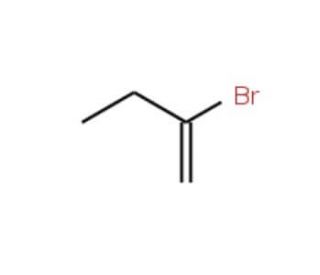

2-Bromo-1-butene (CAS 23074-36-4)
QUICK LINKS
2-Bromo-1-butene is a compound that is of interest in the field of organic synthesis. It is used as an alkylating agent to introduce the butenyl group into various molecular frameworks. Its utility in facilitating carbon-carbon bond formation is a subject of extensive research, particularly in the formation of more complex olefinic structures through coupling reactions. Studies involving 2-Bromo-1-butene often focus on its behavior under various conditions and its reactivity with different nucleophiles, which provides valuable information for reaction optimization. Additionally, this compound is used to explore the mechanisms of elimination reactions and the synthesis of alkenes, contributing to the fundamental understanding of organic reaction pathways. The versatility of 2-Bromo-1-butene as a building block in organic chemistry makes it a vital compound for the creation of a wide array of organic substances.
2-Bromo-1-butene (CAS 23074-36-4) References
- Aldolase antibody activation of prodrugs of potent aldehyde-containing cytotoxics for selective chemotherapy. | Sinha, SC., et al. 2004. Chemistry. 10: 5467-72. PMID: 15378729
- Photodissociation of cyclobutyl bromide at 234 nm studied using velocity map imaging. | Liu, Y., et al. 2006. J Phys Chem A. 110: 5379-85. PMID: 16623465
- Dissociation channels of the 1-buten-2-yl radical and its photolytic precursor 2-bromo-1-butene. | Miller, JL., et al. 2005. J Phys Chem A. 109: 4038-48. PMID: 16833726
- Palladium-based catalytic systems for the synthesis of conjugated enynes by sonogashira reactions and related alkynylations. | Doucet, H. and Hierso, JC. 2007. Angew Chem Int Ed Engl. 46: 834-71. PMID: 17335070
- Synthesis of fluorinated dienes by palladium-catalyzed coupling reactions. | Akkerman, FA., et al. 2008. Chem Asian J. 3: 719-31. PMID: 18348148
- 2,3-Dihydrohomofarnesal: female sex attractant pheromone component of Callosobruchus rhodesianus (Pic). | Shimomura, K., et al. 2010. J Chem Ecol. 36: 824-33. PMID: 20607368
- Synthesis of Substituted 4-, 5-, 6-, and 7-Azaindoles from Aminopyridines via a Cascade C-N Cross-Coupling/Heck Reaction. | Pires, MJ., et al. 2016. Org Lett. 18: 3250-3. PMID: 27331271
- Direct comparison of 3-centre and 4-centre HBr elimination pathways in methyl-substituted vinyl bromides. | Pandit, S., et al. 2016. Phys Chem Chem Phys. 18: 28353-28364. PMID: 27722312
- Discovery of new selective glucocorticoid receptor agonist leads. | Berger, M., et al. 2017. Bioorg Med Chem Lett. 27: 437-442. PMID: 28043796
- High specific activity enantiomerically enriched juvenile hormones: synthesis and binding assay. | Prestwich, GD. and Wawrzeńczyk, C. 1985. Proc Natl Acad Sci U S A. 82: 5290-4. PMID: 3860862
- Practical, stereoselective synthesis of Cecropia juvenile hormone. | Van Tamelen, EE., et al. 1971. Proc Natl Acad Sci U S A. 68: 1294-5. PMID: 5288378
- Vibrational assignment and rotational isomerism of 2-chloro-1-butene and 2-bromo-1-butene | Crowder, G. A., & Smyrl, N. 1971. Journal of Molecular Structure. 10(3): 373-378.
- Theoretical study of the straight-chain C4H7 radical isomers and their dissociation and isomerization transition states | Miller, J. L. 2004. The Journal of Physical Chemistry A. 108(12): 2268-2277.
Ordering Information
| Product Name | Catalog # | UNIT | Price | Qty | FAVORITES | |
2-Bromo-1-butene, 5 g | sc-274367 | 5 g | $143.00 |