
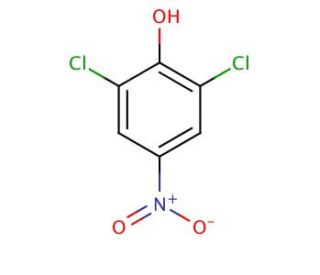

2,6-Dichloro-4-nitrophenol (CAS 618-80-4)
QUICK LINKS
2,6-Dichloro-4-nitrophenol (DCNP) stands as an organic chemical compound. Its utilization extends to a broad range of industrial and scientific applications. 2,6-Dichloro-4-nitrophenol finds utility in chemical and biochemical research, as well as in the manufacturing processes of insecticides, herbicides, and fungicides. Within the realm of scientific research, 2,6-Dichloro-4-nitrophenol finds application in diverse domains. It serves as a key component in the synthesis of organic compounds, aids in the exploration of biochemical and physiological effects. It is also utilized in studies pertaining to enzyme structure and function, including both enzymes involved in protein synthesis and the breakdown of hydrogen peroxide, such as catalase. Moreover, 2,6-Dichloro-4-nitrophenol acts as an inhibitor of the enzyme tyrosinase, which is involved in melanin synthesis. While the exact mechanism of action of 2,6-Dichloro-4-nitrophenol remains not fully elucidated, it is believed to function as an inhibitor of enzymes for protein and macromolecule synthesis. Additionally, it is thought to inhibit the enzymatic activity of catalase, impeding the breakdown of hydrogen peroxide. Furthermore, 2,6-Dichloro-4-nitrophenol is believed to act as an inhibitor of the enzyme tyrosinase, thereby affecting melanin synthesis.
2,6-Dichloro-4-nitrophenol (CAS 618-80-4) References
- Effect of pentachlorophenol and 2,6-dichloro-4-nitrophenol on the activity of cDNA-expressed human alcohol and aldehyde dehydrogenases. | Kollock, R., et al. 2009. Toxicol Lett. 191: 360-4. PMID: 19822198
- Spectroscopic characterization of hydrogen-bonded proton transfer complex between 4-aminopyridine with 2,6-dichloro-4-nitrophenol in different solvents and solid state. | Al-Ahmary, KM., et al. 2014. Spectrochim Acta A Mol Biomol Spectrosc. 126: 260-9. PMID: 24607476
- Spectrophotometric study on the proton transfer reaction between 2-amino-4-methylpyridine with 2,6-dichloro-4-nitrophenol in methanol, acetonitrile and the binary mixture 50% methanol+50% acetonitrile. | Al-Ahmary, KM., et al. 2016. Spectrochim Acta A Mol Biomol Spectrosc. 154: 135-144. PMID: 26520474
- Recent advances in degradation of chloronitrophenols. | Arora, PK., et al. 2018. Bioresour Technol. 250: 902-909. PMID: 29229201
- Microbial degradation kinetics and molecular mechanism of 2,6-dichloro-4-nitrophenol by a Cupriavidus strain. | Min, J., et al. 2020. Environ Pollut. 258: 113703. PMID: 31818627
- Axial Ligand as a Critical Factor for High-Performance Pentagonal Bipyramidal Dy(III) Single-Ion Magnets. | Zhang, B., et al. 2022. Inorg Chem. 61: 19726-19734. PMID: 36417790
- Determination of acid phosphatase in biological fluids using a new substrate, 2,6-dichloro-4-nitrophenyl phosphate. | Teshima, S., et al. 1987. Clin Chim Acta. 168: 231-8. PMID: 3677418
- Phenol sulphotransferase and uridine diphosphate glucuronyltransferase from rat liver in vivo and vitro. 2,6-Dichloro-4-nitrophenol as selective inhibitor of sulphation. | Mulder, GJ. and Scholtens, E. 1977. Biochem J. 165: 553-9. PMID: 411489
- Inhibition of sulfation of phenols in vivo by 2,6-dichloro-4-nitrophenol: selectivity of its action in relation to other conjugations in the rat in vivo. | Koster, H., et al. 1979. Med Biol. 57: 340-4. PMID: 522521
- Inhibition of acetaminophen sulfation by 2,6-dichloro-4-nitrophenol in the perfused rat liver preparation. Lack of a compensatory increase of glucuronidation. | Fayz, S., et al. 1984. Drug Metab Dispos. 12: 323-9. PMID: 6145559
- Selective inhibition of sulfate conjugation in the rat: pharmacokinetics and characterization of the inhibitory effect of 2,6-dichloro-4-nitrophenol. | Koster, H., et al. 1982. Biochem Pharmacol. 31: 1919-24. PMID: 7104024
- The role of sulfation and/or acetylation in the metabolism of the cooked-food mutagen 2-amino-1-methyl-6-phenylimidazo[4,5-b]pyridine in Salmonella typhimurium and isolated rat hepatocytes. | Malfatti, MA., et al. 1994. Chem Res Toxicol. 7: 139-47. PMID: 8199301
- 2,6-Dichloro-4-nitrophenol (DCNP), an alternate-substrate inhibitor of phenolsulfotransferase. | Seah, VM. and Wong, KP. 1994. Biochem Pharmacol. 47: 1743-9. PMID: 8204091
Ordering Information
| Product Name | Catalog # | UNIT | Price | Qty | FAVORITES | |
2,6-Dichloro-4-nitrophenol, 25 g | sc-231167 | 25 g | $43.00 |