
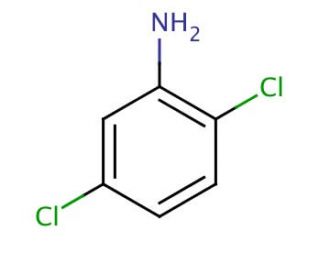

2,5-Dichloroaniline (CAS 95-82-9)
QUICK LINKS
2,5-Dichloroaniline is a chemical compound characterized by the presence of two chlorine atoms substituted at the 2 and 5 positions on an aniline ring. This structural modification imparts specific chemical properties such as increased reactivity and polarity, compared to its parent compound, aniline. 2,5-Dichloroaniline is widely used as an intermediate in the synthesis of dyes and pigments. The dichloro substitutions enhance its ability to undergo nucleophilic substitution reactions, essential for coupling with other aromatic compounds. This functionality is particularly useful in the manufacture of complex molecules where precise chlorine placement provides necessary chemical activity for subsequent transformations. The presence of chlorine also affects the electronic characteristics of the molecule, influencing its interactions within various chemical systems.
2,5-Dichloroaniline (CAS 95-82-9) References
- Targeted cytotoxic somatostatin analog AN-162 inhibits growth of human colon carcinomas and increases sensitivity of doxorubicin resistant murine leukemia cells. | Hohla, F., et al. 2010. Cancer Lett. 294: 35-42. PMID: 20156671
- The inhibitory effect of a novel cytotoxic somatostatin analogue AN-162 on experimental glioblastoma. | Pozsgai, E., et al. 2010. Horm Metab Res. 42: 781-6. PMID: 20665426
- Polychlorinated biphenyl contamination of paints containing polycyclic- and Naphthol AS-type pigments. | Anezaki, K., et al. 2015. Environ Sci Pollut Res Int. 22: 14478-88. PMID: 24809497
- Drug delivery to the malaria parasite using an arterolane-like scaffold. | Fontaine, SD., et al. 2015. ChemMedChem. 10: 47-51. PMID: 25314098
- Bacterial degradation of monocyclic aromatic amines. | Arora, PK. 2015. Front Microbiol. 6: 820. PMID: 26347719
- New Stable Cu(I) Catalyst Supported on Weakly Acidic Polyacrylate Resin for Green C-N Coupling: Synthesis of N-(Pyridin-4-yl)benzene Amines and N,N-Bis(pyridine-4-yl)benzene Amines. | Kore, N. and Pazdera, P. 2016. Molecules. 22: PMID: 28025513
- Antifungal Activity against Botrytis cinerea of 2,6-Dimethoxy-4-(phenylimino)cyclohexa-2,5-dienone Derivatives. | Castro, P., et al. 2019. Molecules. 24: PMID: 30781370
- Enhanced dechlorination and biodegradation of 2-chloroaniline by a 2-aminoanthraquinone-graphene oxide composite under anaerobic conditions. | Lu, H., et al. 2019. Sci Rep. 9: 12376. PMID: 31451740
- Chiral Pentacarboxycyclopentadiene-Based Brønsted Acid-Catalyzed Enantioselective Desymmetrization of Meso-Epoxides by 2-Mercaptobenzothiazoles. | Yuan, C., et al. 2018. ACS Omega. 3: 6820-6826. PMID: 31458851
- Discovery of new VEGFR-2 inhibitors based on bis([1, 2, 4]triazolo)[4,3-a:3',4'-c]quinoxaline derivatives as anticancer agents and apoptosis inducers. | Alsaif, NA., et al. 2021. J Enzyme Inhib Med Chem. 36: 1093-1114. PMID: 34056992
- Comparative Toxicological Evaluation of Tattoo Inks on Two Model Organisms. | Carotenuto, R., et al. 2021. Biology (Basel). 10: PMID: 34943222
- New nano-Fe3O4-supported Lewis acidic ionic liquid as a highly effective and recyclable catalyst for the preparation of benzoxanthenes and pyrroles under solvent-free sonication. | Nguyen, HT., et al. 2018. RSC Adv. 8: 35681-35688. PMID: 35547886
- Hydrodechlorination of Aryl Chlorides Under Biocompatible Conditions. | Gomez, KP., et al. 2022. ACS Omega. 7: 16028-16034. PMID: 35571846
Ordering Information
| Product Name | Catalog # | UNIT | Price | Qty | FAVORITES | |
2,5-Dichloroaniline, 50 g | sc-238373 | 50 g | $47.00 |