
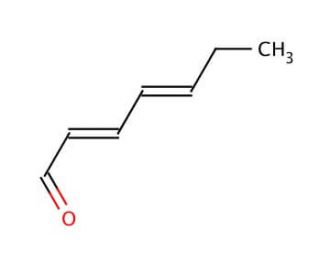

2,4-Heptadienal (CAS 4313-03-5)
QUICK LINKS
2,4-Heptadienal, a colorless liquid with a pungent odor, is an unsaturated aldehyde compound represented by the molecular formula C7H10O. Its versatility makes it valuable in numerous applications, such as a food additive, flavoring agent, and fragrance. Furthermore, it plays a role in the synthesis of synthetic rubber. The compound serves as a starting material for various chemicals, including 2,4-hexadienal. Its significance extends to scientific research, where it serves as a reagent in the creation of other chemicals. In the realm of biology, 2,4-Heptadienal has been instrumental in producing biologically active compounds, including terpenes, steroids, and other natural products. It has also played a key role in the development of polymers like polyurethanes and polyamides. Due to its unsaturated aldehyde nature, 2,4-Heptadienal is reactive and can form new compounds when reacting with other molecules, a process known as aldol condensation. This reaction occurs when an aldehyde reacts with an alkoxide in the presence of an acid catalyst. By reacting with an alkoxide, 2,4-Heptadienal generates a new compound known as an aldol, which can then be further manipulated to produce other compounds. 2,4-Heptadienal′s properties and versatility make it an essential component in various industries, playing a critical role in the synthesis of chemicals and polymers. Its reactivity through aldol condensation allows for the formation of diverse compounds, contributing to scientific research and innovation.
2,4-Heptadienal (CAS 4313-03-5) References
- Hepatic production of apolar aldehydes in rats with carbon tetrachloride-induced cirrhosis. | Ferré, N., et al. 1999. Mol Cell Biochem. 198: 57-60. PMID: 10497878
- Odourous algal-derived alkenes: differences in stability and treatment responses in drinking water. | Satchwill, T., et al. 2007. Water Sci Technol. 55: 95-102. PMID: 17489398
- Age and nutrient limitation enhance polyunsaturated aldehyde production in marine diatoms. | Ribalet, F., et al. 2007. Phytochemistry. 68: 2059-67. PMID: 17575990
- Impact of flavour solvent (propylene glycol or triacetin) on vanillin, 5-(hydroxymethyl)furfural, 2,4-decadienal, 2,4-heptadienal, structural parameters and sensory perception of shortcake biscuits over accelerated shelf life testing. | Yang, N., et al. 2013. Food Chem. 141: 1354-60. PMID: 23790924
- Odour characteristics of seafood flavour formulations produced with fish by-products incorporating EPA, DHA and fish oil. | Peinado, I., et al. 2016. Food Chem. 212: 612-9. PMID: 27374575
- Volatile Oxidation Compounds and Stability of Safflower, Sesame and Canola Cold-Pressed Oils as Affected by Thermal and Microwave Treatments. | Kiralan, M. and Ramadan, MF. 2016. J Oleo Sci. 65: 825-833. PMID: 27725480
- Protective effect of phenolic compounds on carbonyl-amine reactions produced by lipid-derived reactive carbonyls. | Hidalgo, FJ., et al. 2017. Food Chem. 229: 388-395. PMID: 28372190
- A comparative analysis for the volatile compounds of various Chinese dark teas using combinatory metabolomics and fungal solid-state fermentation. | Cao, L., et al. 2018. J Food Drug Anal. 26: 112-123. PMID: 29389546
- Production and Refinement of Omega-3 Rich Oils from Processing By-Products of Farmed Fish Species. | Šimat, V., et al. 2019. Foods. 8: PMID: 31014043
- Application of a Novel Instantized Glycerol Monooleate Ingredient in a Protein-Stabilized Oil-In-Water Emulsion. | Loi, CC., et al. 2020. Foods. 9: PMID: 32899737
- Ultrasound-assisted thawing of frozen white yak meat: Effects on thawing rate, meat quality, nutrients, and microstructure. | Guo, Z., et al. 2021. Ultrason Sonochem. 70: 105345. PMID: 32932225
- Gas-phase ion migration spectrum analysis of the volatile flavors of large yellow croaker oil after different storage periods. | Zhao, T., et al. 2022. Curr Res Food Sci. 5: 813-822. PMID: 35592694
- Identification and evaluation of fishy odorants produced by four algae separated from drinking water source during low temperature period: Insight into odor characteristics and odor contribution of fishy odor-producing algae. | Guo, Q., et al. 2023. Chemosphere. 324: 138328. PMID: 36889477
Ordering Information
| Product Name | Catalog # | UNIT | Price | Qty | FAVORITES | |
2,4-Heptadienal, 1 g | sc-238349 | 1 g | $37.00 |