
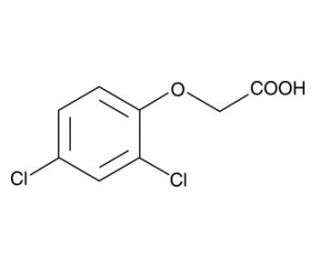

2,4-Dichlorophenoxy Acetic Acid (CAS 94-75-7)
See product citations (1)
QUICK LINKS
2,4-Dichlorophenoxy acetic acid (2,4-D) is a synthetic auxin, belonging to a class of plant growth regulators. It is used as a supplement in plant cell culture media and serves as an active ingredient in herbicides. Its primary function is to control root elongation and cell production by disrupting the actin cytoskeleton. As an herbicide, 2,4-Dichlorophenoxy Acetic Acid is colorless, odorless, and widely utilized for managing broad-leaved weeds, woody plants, and aquatic weeds. It exhibits degradation capabilities through microorganisms present in soil and water. Being a synthetic auxin, 2,4-Dichlorophenoxy Acetic Acid is predominantly utilized globally in various herbicide products, with nine different forms available, often in powder or liquid form. Physically, 2,4-dichlorophenoxyacetic acid is an odorless white to tan solid that sinks in water. It falls under the class of organic compounds known as chlorophenoxyacetates, characterized by a phenoxyacetate structure with chlorine atoms on the benzene ring. The compound is practically insoluble in water and is considered relatively neutral. Its detection is primarily observed in urine samples, and it tends to localize within the cell membrane as predicted by its logP value. 2,4-Dichlorophenoxyacetic acid holds a formal rating as a possible carcinogen (IARC 2B) and is identified as a potentially toxic compound.
2,4-Dichlorophenoxy Acetic Acid (CAS 94-75-7) References
- A proteome analysis of Corynebacterium glutamicum after exposure to the herbicide 2,4-dichlorophenoxy acetic acid (2,4-D). | Fanous, A., et al. 2007. Chemosphere. 69: 25-31. PMID: 17568655
- Biotransformation of p-coumaric acid and 2,4-dichlorophenoxy acetic acid by Azotobacter sp. strain SSB81. | Gauri, SS., et al. 2012. Bioresour Technol. 126: 350-3. PMID: 23127838
- Repositioning of 2,4-dichlorophenoxy acetic acid as a potential anti-inflammatory agent: in silico and pharmaceutical formulation study. | Khedr, MA., et al. 2014. Eur J Pharm Sci. 65: 130-8. PMID: 25245006
- Inhibition-based first-generation electrochemical biosensors: theoretical aspects and application to 2,4-dichlorophenoxy acetic acid detection. | Bollella, P., et al. 2016. Anal Bioanal Chem. 408: 3203-11. PMID: 26874693
- AuNPs-functionalized PANABA-MWCNTs nanocomposite-based impedimetric immunosensor for 2,4-dichlorophenoxy acetic acid detection. | Fusco, G., et al. 2017. Biosens Bioelectron. 93: 52-56. PMID: 27743865
- Modelling aerobic biodegradation of atrazine and 2,4-dichlorophenoxy acetic acid by mixed-cultures. | Carboneras, B., et al. 2017. Bioresour Technol. 243: 1044-1050. PMID: 28764106
- A hybrid process for 2,4-dichlorophenoxy acetic acid herbicidal treatment and its microbial identification by MALDI-TOF mass spectrometry. | Okcu, GD., et al. 2020. Environ Technol. 41: 764-776. PMID: 30092741
- Pesticide Use and Incident Hypothyroidism in Pesticide Applicators in the Agricultural Health Study. | Shrestha, S., et al. 2018. Environ Health Perspect. 126: 97008. PMID: 30256155
- SAUR53 regulates organ elongation and apical hook development in Arabidopsis. | Kathare, PK., et al. 2018. Plant Signal Behav. 13: e1514896. PMID: 30260266
- Moderation of physiological responses in rice plants with Azolla under 2,4-Dichlorophenoxy acetic acid stress. | De, AK., et al. 2019. Mol Biol Rep. 46: 59-66. PMID: 30350235
- Study of visible-light photocatalytic degradation of 2,4-dichlorophenoxy acetic acid in batch and circulated-mode photoreactors. | Safa, S., et al. 2019. J Environ Health Sci Eng. 17: 233-245. PMID: 31297211
- The usage of orange pulp activated carbon in the adsorption of 2,4-dichlorophenoxy acetic acid from aqueous solutions. | Angın, D. and Güneş, S. 2021. Int J Phytoremediation. 23: 436-444. PMID: 33012178
- Synthesis of a plasmonic AgCl and oxygen-rich Bi24O31Cl10 composite heterogeneous catalyst for enhanced degradation of tetracycline and 2,4-dichlorophenoxy acetic acid. | Adenuga, D., et al. 2021. RSC Adv. 11: 36760-36768. PMID: 35494340
- Herbicides 2,4-Dichlorophenoxy Acetic Acid and Glyphosate Induce Distinct Biochemical Changes in E. coli during Phenotypic Antibiotic Resistance: A Raman Spectroscopic Study. | Singh, S., et al. 2022. J Phys Chem B. 126: 8140-8154. PMID: 36205931
Ordering Information
| Product Name | Catalog # | UNIT | Price | Qty | FAVORITES | |
2,4-Dichlorophenoxy Acetic Acid, 10 g | sc-205097 | 10 g | $26.00 | |||
2,4-Dichlorophenoxy Acetic Acid, 25 g | sc-205097A | 25 g | $37.00 | |||
2,4-Dichlorophenoxy Acetic Acid, 100 g | sc-205097B | 100 g | $48.00 | |||
2,4-Dichlorophenoxy Acetic Acid, 250 g | sc-205097C | 250 g | $94.00 | |||
2,4-Dichlorophenoxy Acetic Acid, 500 g | sc-205097D | 500 g | $317.00 |